Diversity, Division, and the Rural-Urban Divide (1920–1929)
Introduction: The Dual Realities of the Roaring Twenties
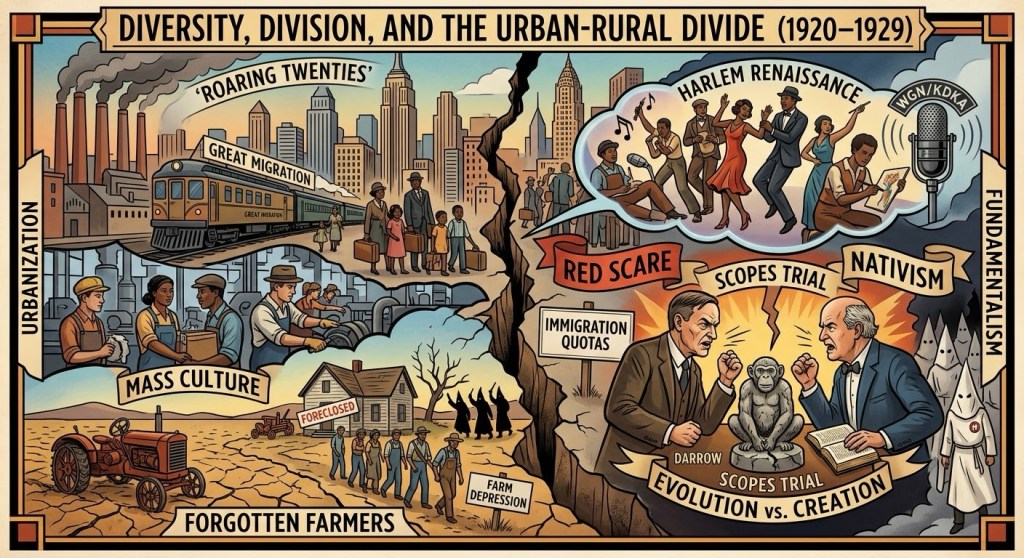
While the popular memory of the 1920s is dominated by images of urban prosperity, jazz clubs, and stock market fortunes, this glittering facade masked deep cultural, racial, and economic fractures. The 1920 U.S. Census marked a historic turning point: for the first time in American history, more than half the population (51.2%) resided in urban areas rather than rural towns and farms.
This demographic shift ignited a fiery cultural battle between two distinct Americas—the rapidly modernizing, secular, and multicultural cities versus the traditional, agrarian, and fundamentalist countryside.
1. The Great Migration and the Harlem Renaissance
Driven by brutal Jim Crow segregation laws, systemic disenfranchisement, and widespread economic exploitation in the rural South, over 1.5 million African Americans migrated to Northern and Midwestern industrial hubs between 1910 and 1930.
The Urban Crucible
Cities such as New York, Chicago, Detroit, and Philadelphia experienced unprecedented growth in their Black populations. While Northern cities offered higher wages and relief from legalized segregation, migrants still confronted racial prejudice, housing discrimination (redlining), and race riots, such as the violent encounters during the “Red Summer” of 1919.
The Harlem Renaissance: Reclaiming the Black Identity
In Harlem, Manhattan, a concentration of Black intellectuals, writers, artists, and musicians birthed the “New Negro Movement”—later known as the Harlem Renaissance:
- Literary Masterpieces: Langston Hughes, Zora Neale Hurston, Claude McKay, and Jean Toomer produced poems, essays, and novels that celebrated Black culture while confronting racial injustice.
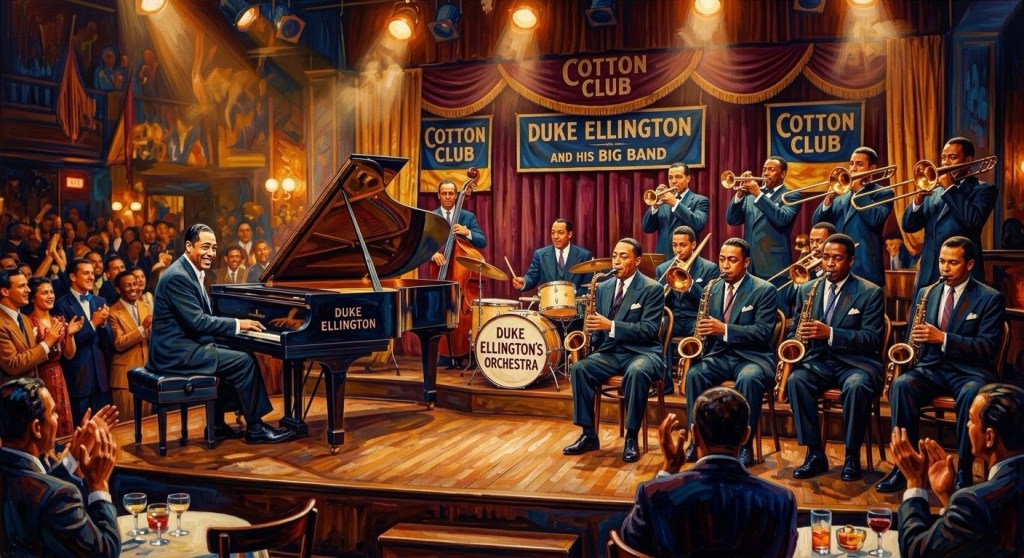
- Musical Genius: Jazz and blues legends like Duke Ellington, Louis Armstrong, Bessie Smith, and Cab Calloway performed at world-famous venues like the Cotton Club and Apollo Theater.
- Visual Arts: Artists like Aaron Douglas transformed American art with bold, African-influenced modernist murals and paintings.
Historical Photo Callout: Harlem & The Great Migration
- Photo Focus: African American Migrants Arriving in Chicago (c. 1922)
Description: Families arriving at Chicago’s Illinois Central train station carrying packed luggage, symbolizing the hope and mobility of the Great Migration. - Photo Focus: Duke Ellington and His Band at the Cotton Club (1927)
Description: Duke Ellington leading his orchestra in Harlem, whose radio broadcasts brought Black big band jazz into millions of white and Black households nationwide.
Black Population Growth in Major Northern Cities (1910–1930)
City
1910 Black Population
1920 Black Population
1930 Black Population
Total % Increase (1910–1930)
New York City
91,709
152,467
327,706
+257%
Chicago
44,103
109,458
233,903
+430%
Detroit
5,741
40,838
120,066
+1,991%
Philadelphia
84,459
134,229
219,599
+160%
2. The Forgotten Farmers: Rural Economic Depression
While industrial output and urban wages surged in the 1920s, American agriculture collapsed into a severe, long-term depression nearly a decade before the 1929 stock market crash.
The Post-WWI Price Collapse
During World War I, the U.S. government encouraged farmers to expand production to feed European allies. Farmers took on heavy debt to buy additional acreage and mechanized tractors. However, when European agriculture recovered post-war and wartime price guarantees ended, agricultural markets collapsed:
- Wheat prices plunged from $2.16 per bushel in 1919 to $1.03 in 1921.
- Cotton prices fell from 35 cents per pound in 1919 to 16 cents in 1921.
Foreclosures and Rural Flight
Unable to pay off mortgage debt and equipment loans, hundreds of thousands of farm families lost their land through foreclosures. Rural banks failed by the thousands throughout the decade. Over 3 million people abandoned rural farming communities in the 1920s to seek industrial factory work in cities.
Historical Photo Callout: Rural Hardship
- Photo Focus: Foreclosure Auction on a Midwest Farm (1924)
Description: Neighbors gathering outside a bankrupt farm in Iowa as a sheriff auctions off machinery and livestock to cover debt.
U.S. Agriculture & Farm Economics (1919–1929)
Economic Metric
1919 Peak
1921 Collapse
1929 Pre-Crash
Total Gross U.S. Farm Income
$17.7 Billion
$10.5 Billion
$11.9 Billion
Average Price of Wheat (per bushel)
$2.16
$1.03
$1.04
Average Price of Cotton (per pound)
$0.35
$0.16
$0.17
Annual Bank Failures (Mostly Rural)
63 banks
505 banks
659 banks
3. Nativism, the Red Scare, and the Ku Klux Klan
Rapid immigration, urbanization, and wartime hysteria triggered a powerful conservative backlash centered on nativism, xenophobia, and racial animosity.
The First Red Scare and the Palmer Raids (1919–1921)
Fears of Bolshevik communist revolution following World War I led to widespread civil liberties abuses. Attorney General A. Mitchell Palmer directed the “Palmer Raids,” arresting thousands of suspected radicals, anarchists, and foreign-born workers without warrants, leading to mass deportations. The controversial trial and 1927 execution of Italian anarchist immigrants Sacco and Vanzetti highlighted deep anti-immigrant bias in the judicial system.
The National Origins Acts (1921 & 1924)
In response to anti-immigrant sentiment, Congress passed restrictive immigration legislation designed to preserve white Anglo-Saxon Protestant hegemony:
- Emergency Quota Act of 1921: Capped total immigration and set country quotas at 3% of foreign-born residents present in the 1910 census.
- Immigration Act of 1924 (Johnson-Reed Act): Lowered the quota to 2% based on the 1890 census—specifically targeting Southern and Eastern European immigrants (Italians, Poles, Russian Jews) while completely banning immigration from East Asia.
The Resurgence of the Ku Klux Klan
Reestablished at Stone Mountain, Georgia in 1915, the “Second Klan” exploded into a mainstream national movement in the early 1920s, boasting between 3 and 5 million members:
- Expanded Targets: Beyond Black Americans, the 1920s KKK aggressively targeted Catholics, Jews, immigrants, and modern secular influences.
- National Reach: The organization gained significant political control in Midwestern and Western states like Indiana, Ohio, Oregon, and Colorado. In August 1925, over 30,000 unmasked Klansmen marched down Pennsylvania Avenue in Washington, D.C.
Historical Photo Callout: Nativism & Political Friction
- Photo Focus: Ku Klux Klan Parade in Washington, D.C. (1925)
Description: Tens of thousands of white-robed Klansmen marching down Pennsylvania Avenue past the U.S. Capitol building, demonstrating the organization’s mainstream political reach at its peak.
Impact of Immigration Quota Acts on U.S. Inflows (1920 vs. 1925)
Region / Country of Origin
1920 Annual Immigrants
1925 Annual Immigrants (Post-Quota)
% Reduction
Italy (Southern Europe)
95,145
6,203
-93.5%
Poland (Eastern Europe)
48,440
5,982
-87.7%
Russia / USSR
34,228
2,248
-93.4%
Great Britain & Ireland
38,470
62,572
+62.6% (Favored)
4. Modernism vs. Traditionalism: The Scopes “Monkey” Trial
The cultural clash between urban modernism and rural fundamentalist religion culminated in Dayton, Tennessee in July 1925 with the trial of John T. Scopes.
The Butler Act and Evolution in Schools
Tennessee passed the Butler Act in March 1925, making it a crime to teach any theory that denied the biblical story of divine creation or posited that man descended from lower animals. The American Civil Liberties Union (ACLU) offered to defend any teacher willing to test the law’s constitutionality. John Scopes, a 24-year-old high school biology teacher, accepted.
Clashing Titans and Media Circus
The trial brought together two of America’s most formidable public figures:
- William Jennings Bryan: Three-time Democratic presidential candidate and evangelical leader led the prosecution.
- Clarence Darrow: Renowned defense attorney and agnostic champion of civil rights represented Scopes.
For eight days, the trial turned into a national media spectacle—the first trial in American history broadcast live over national radio (WGN). The climax occurred when Darrow called Bryan himself to the witness stand as an expert witness on the Bible, ruthlessly questioning him on literal biblical interpretation.
Although Scopes was convicted and fined $100 (a verdict later overturned on a technicality), the trial exposed the deep, enduring cultural chasm between scientific secularism and religious fundamentalism in modern America.
Historical Photo Callout: The Scopes Trial
- Photo Focus: Clarence Darrow and William Jennings Bryan in Dayton Courtroom (1925)
Description: Darrow (left) and Bryan (right) leaning over the counsel table in the sweltering Dayton courtroom during heated arguments over science and faith.
Conclusion: A Fractured Nation
Far from being a uniform party of prosperity, the 1920s was a battleground for America’s identity. As cities embraced ethnic diversity, jazz, scientific inquiry, and consumer freedom, rural and traditionalist factions fought fiercely to preserve an older Anglo-Protestant social order. These deep socio-economic and cultural fault lines laid the groundwork for the political alignments and social debates that would reshape the nation during the Great Depression and beyond.


Leave a comment