The Roaring Twenties: Modernity, Mass Culture, and Everyday Life (1920–1929)
Introduction: The Dawn of the Modern American Era
The decade following World War I was one of the most turbulent, transformative, and explosive periods in American history. As doughboys returned from Europe and factories transitioned from wartime production to civilian manufacturing, the United States underwent a dramatic structural shift. For the first time in national history, the 1920 U.S. Census revealed that more Americans lived in urban areas than in rural towns.
This urbanization paved the way for a distinctively modern consumer culture. Fueled by rapid technological breakthroughs, rising real wages, and an unprecedented expansion of consumer credit, daily life for millions of Americans was fundamentally rewritten.
1. The Automobile Revolution and Changing Landscapes
No single technology reshaped American geography, industry, and social mobility in the 1920s more profoundly than the automobile.
Henry Ford and Assembly Line Mass Production
Prior to the 1920s, motorcars were luxury items reserved for the wealthy elite. Henry Ford revolutionized the automotive industry by perfecting moving assembly line mechanics at his Highland Park plant in Michigan. By standardizing parts and reducing labor inefficiencies, Ford brought the cost of a brand-new Model T down from $850 in 1908 to an extraordinary $290 by 1925—an amount equivalent to less than three months’ wages for an average factory worker.
Social and Economic Ripple Effects
The ubiquity of the automobile transformed the American ecosystem:
- Spin-Off Industries: Demand skyrocketed for vulcanized rubber, plate glass, petroleum, and refined steel.
- Infrastructure Boom: State and federal governments launched highway construction programs, building thousands of miles of paved roads.
- Suburban Growth: The commute was born. Families were no longer constrained to live within walking distance or trolley access of their workplaces.
- Youth Independence: The car provided young adults with unchaperoned mobility, changing dating customs and social recreation forever.
Photo Callout: The Automobile Age
- Photo Focus: Ford Assembly Line, Detroit (1924)
Description: Workers assemble Ford Model T chasses on the moving assembly line. By 1925, Ford was producing a completed Model T every 10 seconds. - Photo Focus: Downtown Los Angeles Traffic Jam (1926)
Description: Gridlock at 7th and Broadway in Los Angeles, illustrating how automobile adoption rapidly outpaced early city infrastructure and traffic management.
Data Chart 1: Automobile Growth & Affordability (1920–1929)
Year
Registered Passenger Cars in U.S.
Average Price of Model T
U.S. Population per Car
1920
7.5 Million
$395
~14.1 Persons
1923
13.5 Million
$364
~8.3 Persons
1926
19.2 Million
$290
~6.1 Persons
1929
23.1 Million
$290
~5.3 Persons
2. The Electric Home and the Consumer Credit Revolution
Along with the motorcar came the widespread electrification of American homes. In 1912, only 16% of U.S. households had electricity; by 1929, that figure had climbed to nearly 70% in urban areas.
“Buy Now, Pay Later”: The Rise of Installment Buying
Before the 1920s, American culture largely viewed personal debt as a moral failure. The 1920s erased this taboo through the introduction of installment credit. Manufacturers and retailers encouraged families to purchase big-ticket items with “a small down payment and easy monthly installments.”
By 1929:
- 60% of all automobiles were purchased on credit.
- 80% of radios and 70% of household furniture were bought on installment plans.
- Total outstanding consumer credit expanded from under $1 billion in 1920 to over $3 billion by 1929.
Domestic Appliances and the Paradox of Housework
Advertisers marketed new appliances—electric refrigerators, vacuum cleaners, washing machines, and automatic irons—as “labor-saving devices” designed to liberate housewives. However, historians note a key paradox: as technology improved, social standards of cleanliness rose sharply. Daily vacuuming, frequent laundry cycles, and higher culinary expectations meant the average housewife’s weekly work hours remained largely unchanged.
Photo Callout: Modern Domestic Life
- Photo Focus: 1920s General Electric Refrigerator Advertisement
Description: Print advertisement emphasizing modern hygiene, silent electrical cooling, and installment purchase terms for middle-class homes.
Data Chart 2: Household Appliance Adoption & Credit Financing (1920 vs. 1929)
Consumer Product / Metric
1920 Level
1929 Level
% Bought on Credit (1929)
Mechanical Refrigerators
Less than 10,000 units sold
~800,000 units sold
65%
Washing Machines
8% of households
24% of households
55%
Vacuum Cleaners
9% of households
30% of households
50%
Average Household Savings Rate
12.8% of income
4.2% of income
N/A
3. Mass Media and Nationalized Culture: Radio and Cinema
Before 1920, American culture was highly regionalized. Local news, regional accents, and municipal entertainments dominated daily life. The sudden growth of mass media forged the first synchronized, national popular culture.
The Radio Boom
Commercial radio broadcasting began on November 2, 1920, when Pittsburgh station KDKA broadcast the results of the Harding-Cox presidential election. The medium expanded with staggering speed:
- 1921: 5 licensed radio stations nationwide.
- 1923: Over 500 radio stations operating across the country.
- 1926 & 1927: Formation of national networks—the National Broadcasting Company (NBC) and the Columbia Broadcasting System (CBS)—allowing millions across coastlines to listen to identical news, comedy, and sports broadcasts simultaneously.
The Golden Age of Silent Films and “Talkies”
Weekly movie attendance soared from 40 million in 1922 to over 90 million by 1929. Movie palaces—gilded, air-conditioned theaters—offered working Americans affordable luxury.
In 1927, Warner Bros. released The Jazz Singer, featuring Al Jolson. As the first feature-length motion picture with synchronized dialogue, it signaled the end of the silent era and revolutionized mass entertainment.
Photo Callout: Mass Entertainment
- Photo Focus: Family Gathered Around an Atwater Kent Radio (1928)
Description: An American family listening to a national evening broadcast on their cabinet radio set. - Photo Focus: Marquee of the Chicago Theatre (1925)
Description: The grand entrance of the Chicago Theatre, one of the iconic movie palaces built during the 1920s cinema boom.
Data Chart 3: Expansion of Mass Media (1920–1930)
Year
Commercial Radio Stations
% Household Radio Ownership
Weekly U.S. Movie Attendance
1920
1
Less than 0.1%
35 Million
1923
556
1.0%
50 Million
1926
520
20.0%
70 Million
1930
618
40.3%
90 Million
4. Prohibition, the Jazz Age, and Social Rebellion
The “Noble Experiment”
In January 1920, the 18th Amendment and the Volstead Act took effect, banning the manufacture, transportation, and sale of intoxicating liquors. Rather than eliminating alcohol consumption, Prohibition created a massive underground black market.
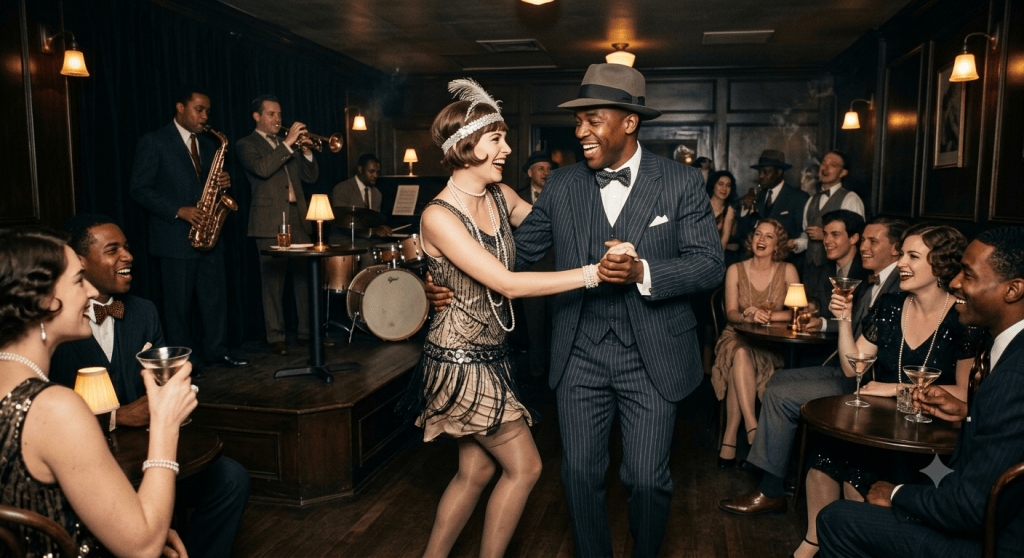
Illegal drinking dens, known as speakeasies, proliferated rapidly—New York City alone hosted an estimated 30,000 to 100,000 speakeasies by the mid-1920s. Organized crime syndicates, headed by figures like Al Capone in Chicago, gained immense power and wealth through bootlegging, racketeering, and corrupting municipal authorities.
The “Flapper” and the New Woman
With the ratification of the 19th Amendment in 1920 granting women the right to vote, social attitudes regarding gender roles began shifting. The iconic flapper represented a rejection of Victorian formality:
- Fashion: Hemlines rose to the knee, waistlines dropped, corsets were discarded, and hair was cut into short “bobs.”
- Social Behavior: Young women drank in speakeasies, smoked cigarettes in public, drove automobiles, and danced to fast-paced jazz music.
The Sound of the Decade: Jazz
Originating among African American musicians in New Orleans, jazz traveled north along rail lines and riverboats to Chicago, Kansas City, and New York. Virtuosos like Louis Armstrong, Duke Ellington, and Bessie Smith defined the soundtrack of urban nightlife, popularizing dances like the Charleston, the Shimmy, and the Black Bottom.
Photo Callout: Prohibition and Social Life
- Photo Focus: Federal Agents Pouring Out Confiscated Liquor (1922)
Description: Prohibition enforcement officers dumping illegal whiskey down a sewer drain during a raid in Chicago. - Photo Focus: Flappers Dancing the Charleston (1926)
Description: Young women demonstrating the fast-moving Charleston dance steps outside a venue in New York.
Conclusion: The Modern Template and Underlying Fragility
The Roaring Twenties forged the blueprint of modern American society: an economy driven by consumer desire, mass communications, automotive independence, and evolving social liberties.
However, beneath the glittering surface of speakeasies, radio shows, and shiny new automobiles lay critical vulnerabilities. Much of the decade’s prosperity rested on escalating installment debt, stagnant agricultural incomes, and unbridled stock market speculation. When the financial bubble burst in October 1929, the golden age of mass consumption came to an abrupt end, giving way to the dark realities of the Great Depression.


Leave a comment