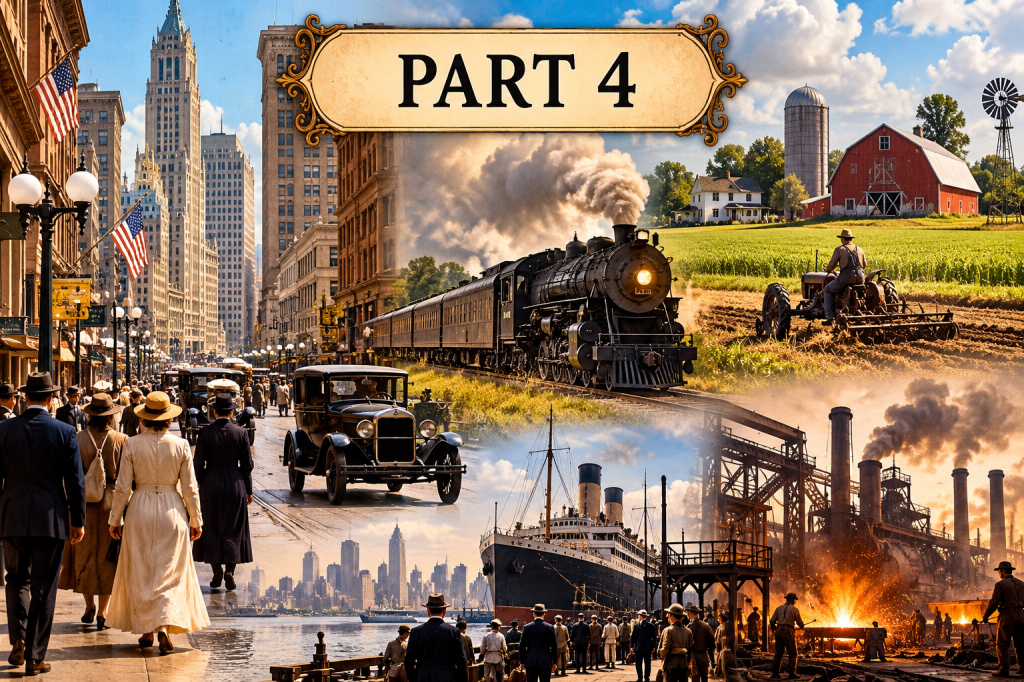
America, 1900–1920
Day 4 — Progressivism, Wilson, and the Coming of World War
Expanded Edition: 1912–1915
Introduction
America Enters a Dangerous New Era
By 1912, the United States was becoming recognizably modern.
Automobiles were appearing on city streets and country roads. Electric lights were spreading through cities. Telephones connected more homes and businesses. Department stores and mail-order catalogs offered Americans an expanding selection of manufactured goods.
But modernization was uneven.
A wealthy family in New York might live in a large home with electricity, indoor plumbing, servants, a telephone, and an automobile.
A rural farm family might still rely on kerosene lamps, an outhouse, a wood stove, horses, and a hand pump for water.
For millions of working-class Americans, life meant long hours in factories, crowded apartments, streetcars, inexpensive restaurants, and careful household budgets.
America was modernizing—but not everyone experienced modern life in the same way.
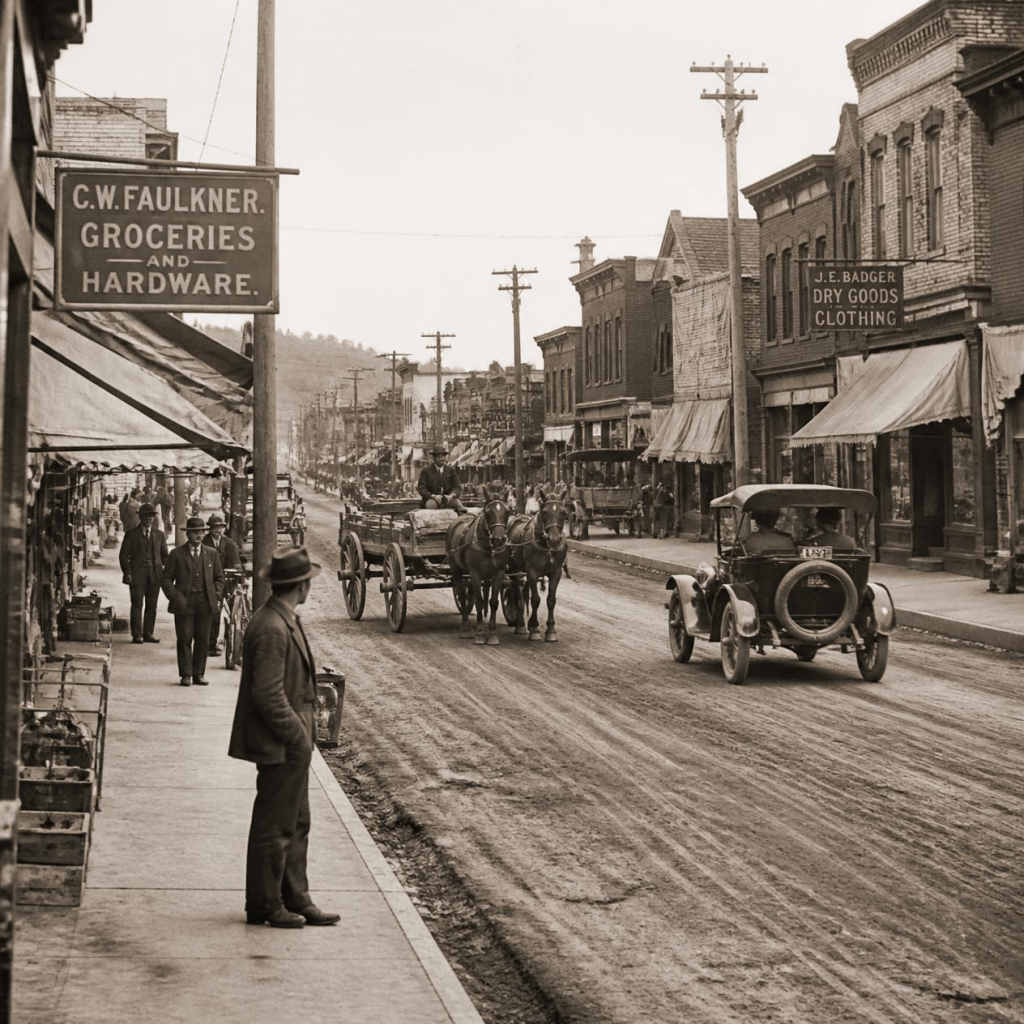
https://lanternstreets.com/featured/early-20th-century-small-town-street-james-inlow.html
Chapter 1
The Election of 1912
The presidential election of 1912 was extraordinary.
The Republican Party was divided between President William Howard Taft and former President Theodore Roosevelt.
Roosevelt eventually formed the Progressive Party and became its candidate.
Woodrow Wilson represented the Democratic Party, while Eugene V. Debs ran for the Socialist Party.
The campaign reflected major questions about American society.
Should corporations be more heavily regulated?
Should workers receive greater protections?
Should women receive the right to vote?
How much power should the federal government possess?
Daily Life: Following the Election
For ordinary Americans, politics was experienced through newspapers, political rallies, speeches, posters, cartoons, and conversations.
A family might read the morning newspaper at the breakfast table.
Men might discuss politics at the barber shop or saloon.
Women gathered at church groups, social organizations, and homes to discuss reform and suffrage.
Political rallies could attract thousands.
Candidates traveled by train from city to city, giving speeches to large crowds.
Radio did not yet exist as a mass medium, so newspapers remained extremely important.
A person who wanted to know what was happening nationally often depended upon the newspaper arriving that morning.
Chapter 2
Theodore Roosevelt’s New Nationalism
Roosevelt’s Progressive campaign called for a stronger federal government capable of dealing with the problems created by industrialization.
His proposals included labor protections, social welfare programs, corporate regulation, conservation, and political reform.
The campaign appealed to many Americans who believed that large corporations had become too powerful.
Daily Life: Reform in the Neighborhood
Progressivism could be seen in ordinary communities.
Reformers investigated crowded housing.
Women organized campaigns for clean streets and better schools.
Doctors and public-health officials fought diseases associated with contaminated water and poor sanitation.
Settlement houses helped immigrant families learn English, obtain assistance, and find educational opportunities.
Progressive reform was not simply something discussed by politicians.
It was becoming part of everyday community life.
Chapter 3
Woodrow Wilson
Woodrow Wilson campaigned on a program called New Freedom.
He promised reforms involving banking, corporations, and competition.
Wilson’s election reflected the divisions within the Republican Party.
Daily Life: Election Day
Voting itself was a very different experience from today.
Ballots were generally paper.
Polling places could be located in schools, public buildings, courthouses, fire stations, or other community locations.
Women in most states still could not vote in presidential elections.
Many African Americans in the South faced barriers designed to prevent them from voting.
For men who could vote, election day was often a highly social event.
People gathered around polling places, discussed candidates, read newspapers, and followed election returns.
Without television or radio, election-night information spread through newspapers, telegraph offices, public gatherings, and word of mouth.
Chapter 4
Woodrow Wilson Takes Office
Wilson became president in March 1913.
Democrats controlled Congress, creating an opportunity for major legislation.
The federal government began taking a more active role in economic regulation.
Daily Life: Washington and the Presidency
Most Americans did not see the president directly.
Instead, they encountered the presidency through newspapers, photographs, political cartoons, speeches, and official announcements.
Photographs of Wilson and his family appeared in newspapers.
The White House became increasingly important as a symbol of national leadership.
Presidential decisions could now reach ordinary households quickly through newspapers and telegraph reports.
The country was developing a more connected political culture.
Chapter 5
The Federal Reserve
The Federal Reserve System was created in 1913.
Its creation followed decades of financial instability and the lessons of the Panic of 1907.
Daily Life: Money and Banking
For ordinary Americans, banking was often much more personal than it is today.
Families might keep savings in a local bank.
Farmers borrowed money to purchase land, livestock, seed, or equipment.
Small businesses depended on local banks for credit.
Many people still distrusted banks because financial crises could destroy savings and businesses.
Checks existed, but cash remained extremely important.
Credit was becoming increasingly important as consumer culture expanded.
The changing financial system would eventually affect nearly every American household.
Chapter 6
The Federal Income Tax
The Sixteenth Amendment took effect in 1913.
The federal government now had a constitutional basis for imposing an income tax.
Daily Life: Household Finances
Family budgets were carefully managed.
A working-class household might have to divide wages among:
- Rent
- Food
- Coal or wood
- Clothing
- Transportation
- School expenses
- Medical costs
- Household necessities
Many families saved money by growing some of their own food, repairing clothing, preserving vegetables, and purchasing goods only when necessary.
There were no modern credit cards.
A large purchase could represent a significant financial decision.
The growing economy, however, was creating more opportunities for consumers to purchase manufactured goods.
Chapter 7
The Clayton Antitrust Act
The Clayton Antitrust Act of 1914 represented another effort to regulate concentrated economic power.
The law also provided important protections for labor organizations.
Daily Life: Working for a Corporation
Large corporations were becoming major employers.
A worker might spend the entire day performing one specialized task.
The work could be repetitive and physically demanding.
Factories were noisy.
Air could be filled with dust, smoke, oil, or chemical fumes.
Workers often wore simple work clothes designed for durability rather than comfort.
The whistle or factory clock frequently determined the rhythm of the workday.
For many workers, the factory bell meant the beginning and end of life organized around industrial time.
Chapter 8
The Panama Canal Opens
The Panama Canal opened in 1914.
It was one of the great engineering achievements of the era.
Daily Life: The World Gets Smaller
Ordinary Americans were increasingly aware of distant places.
Newspapers published stories from Europe, Asia, Latin America, and Africa.
Steamships crossed the oceans.
Telegraph cables transmitted messages across continents and seas.
Travel was becoming faster.
A person could travel from New York to Europe by steamship in a matter of days rather than weeks.
The world was becoming interconnected in ways earlier generations could hardly have imagined.
Chapter 9
The Automobile Becomes Part of American Life
The automobile was no longer simply a curiosity.
Ford’s Model T was becoming increasingly popular.
Daily Life: Owning a Car
For families who owned automobiles, everyday life began changing.
Sunday drives became popular.
Families could visit relatives in neighboring towns without depending entirely on railroad schedules.
Farmers could reach markets more easily.
Doctors could travel to patients.
Businesses could deliver products.
But automobile ownership also created new expenses.
Families needed gasoline, tires, repairs, and maintenance.
Roads became an increasingly important political issue.
The automobile was creating an entirely new way of living.
Chapter 10
The Moving Assembly Line
Ford’s moving assembly line transformed automobile production.
Daily Life: The Factory Worker
Assembly-line work could be monotonous.
A worker might perform the same movement repeatedly for hours.
The pace of production was determined by the machinery and the production schedule.
Workers could produce far more automobiles than under older manufacturing systems.
Mass production lowered prices.
This created an important connection:
Factory efficiency → lower prices → more consumers → greater production → more factory jobs.
The cycle helped create modern mass consumer society.
Chapter 11
The Changing Workplace
Industrial work remained difficult.
Workers sought higher wages, shorter hours, safer conditions, and recognition of unions.
Daily Life: The Working Family
A working-class family often depended upon multiple wage earners.
Children might contribute income through part-time or full-time employment.
Teenagers might leave school early to work.
Women often worked in factories, stores, offices, laundries, or domestic service.
The family budget could depend upon every paycheck.
A serious workplace injury could therefore become a financial disaster.
Workers had few of the protections that employees commonly expect today.
Chapter 12
Women and the Suffrage Movement
Women continued their campaign for voting rights.
Suffragists organized marches, meetings, petitions, speeches, and publicity campaigns.
Daily Life: The Suffragist
A woman involved in the suffrage movement might spend her day working in an office or caring for children and her evening attending a suffrage meeting.
Women distributed pamphlets and newspapers.
They organized lectures.
They spoke at public gatherings.
They traveled by train to campaign in other communities.
Some faced ridicule and opposition.
The movement required enormous amounts of volunteer work.
The campaign was becoming a part of women’s everyday public lives.
Chapter 13
Women in the Workforce
Women were increasingly visible in workplaces.
They worked as teachers, nurses, telephone operators, clerks, salespeople, factory workers, stenographers, and domestic servants.
Daily Life: The Working Woman
A woman working in an office might ride a streetcar into the city each morning.
She could spend the day typing letters, filing documents, answering telephones, or keeping accounts.
Clothing reflected social expectations.
Women commonly wore long skirts and blouses or dresses, with hats worn outdoors.
Young women working in department stores might spend many hours standing.
Factory workers often faced hot, crowded conditions.
Women earned wages, but their pay was generally lower than men’s.
Employment nevertheless provided some women with financial independence.
Chapter 14
African Americans and the Great Migration
African Americans increasingly began moving from the rural South toward northern and Midwestern cities.
Daily Life: Leaving the South
A family preparing to move might sell or leave behind property, furniture, animals, and familiar surroundings.
The journey north often meant traveling by train.
People carried suitcases, trunks, clothing, family photographs, documents, and treasured possessions.
Northern cities promised jobs in factories, meatpacking plants, railroads, and other industries.
But migrants also encountered racial discrimination and segregated neighborhoods.
The Great Migration would profoundly change American cities.
Chapter 15
The Birth of the Modern Music Industry
Music was becoming increasingly accessible.
Families gathered around pianos.
Sheet music was sold in stores.
Traveling performers brought new songs to towns across the country.
Phonographs allowed people to hear recorded music in their homes.
Daily Life: An Evening at Home
After dinner, a family might gather in the parlor.
Someone might play the piano.
Another family might listen to a phonograph.
Children might sing popular songs.
Neighbors could visit.
There was no television to dominate the evening.
Home entertainment was often participatory.
Families created their own entertainment rather than simply consuming it.
Chapter 16
Hollywood Begins to Rise
Motion pictures were becoming a major industry.
Daily Life: Going to the Movies
Going to a movie could be an inexpensive form of entertainment.
People might visit a small theater after work or on the weekend.
Audiences watched silent films accompanied by live piano or other music.
Children loved comedy films.
Adults watched dramas, romances, adventures, westerns, and news events.
For many immigrants, movies were also an important way to learn about American customs and language.
Cinema was becoming a shared national experience.
Chapter 17
Life in the American Home
The American home was changing, but not equally everywhere.
Daily Life: The Kitchen
The kitchen remained the center of household work.
Women often prepared meals from basic ingredients.
Bread, meat, potatoes, beans, vegetables, eggs, milk, and preserved foods were common staples.
Refrigeration was limited.
Many families used iceboxes.
Food was preserved through:
- Canning
- Drying
- Salting
- Smoking
- Pickling
Cooking was labor intensive.
A wood or coal stove produced heat but also made the kitchen hot.
Electric appliances were still relatively new.
Cleaning
Laundry could take an entire day.
Clothing was soaked, scrubbed, boiled, rinsed, wrung out, and hung outdoors.
Ironing required heating an iron on the stove.
Household work consumed enormous amounts of time.
Chapter 18
The World Goes to War
In 1914, war erupted in Europe.
Daily Life: Reading War News
Americans followed the war through newspapers.
Front-page headlines described battles thousands of miles away.
Families gathered around newspapers to learn about relatives living in Europe.
Immigrant communities often followed the war closely because friends and relatives might be serving in European armies.
Photographs of soldiers, battlefields, refugees, and destruction appeared in newspapers and magazines.
The war seemed distant geographically, but it was becoming emotionally close.
Chapter 19
America Watches Europe
The United States remained neutral.
Daily Life: Neutrality
American life continued.
Factories produced goods.
Children went to school.
People attended baseball games.
Families went shopping.
Workers went to factories.
Farmers harvested crops.
But the war affected everyday conversations.
European immigrants debated which side deserved support.
Churches discussed the conflict.
Newspapers printed editorials and battlefield reports.
Americans increasingly understood that the war could eventually affect their own country.
Chapter 20
The Lusitania
On May 7, 1915, the British passenger liner Lusitania was sunk by a German submarine.
The deaths of American passengers intensified debate in the United States.
Daily Life: War Comes Closer
The sinking became a household topic.
Newspapers published dramatic headlines.
Families discussed whether Germany had gone too far.
Political cartoons portrayed the dangers of submarine warfare.
Some Americans demanded stronger action.
Others continued to believe that the United States should remain out of the war.
For ordinary Americans, international politics was becoming personal.
Chapter 21
America in 1915
By the end of 1915, the United States was entering a new phase.
The automobile was changing transportation.
The assembly line was changing work.
The Federal Reserve was changing banking.
The income tax was changing federal finances.
Women were changing their role in public life.
African Americans were beginning a major movement toward northern cities.
Motion pictures were changing entertainment.
Recorded music was changing the home.
The Panama Canal was changing international transportation.
And World War I was changing the international environment.
Daily Life in 1915
A typical American day could begin with a newspaper delivered to the front door.
Breakfast might include eggs, bacon, toast, oatmeal, coffee, or fruit.
A worker might walk or ride a streetcar to work.
An automobile might pass through the street.
Factories and offices operated according to strict schedules.
Children attended neighborhood schools.
Women managed households or went to work.
Families purchased goods from local stores or ordered products through catalogs.
Evenings might be spent reading, playing music, visiting neighbors, attending church activities, going to a movie, or listening to a phonograph.
Life was still physically demanding.
But the modern world was clearly arriving.
A Closer Look at Everyday America, 1912–1915
Transportation
Americans traveled by:
- Walking
- Horse and wagon
- Streetcar
- Train
- Bicycle
- Automobile
- Steamship
Airplanes existed but were not yet ordinary transportation.
Communication
People communicated through:
- Letters
- Telegraphs
- Telephones
- Newspapers
- Magazines
- Postcards
The telephone was increasingly important in cities.
But written letters remained essential.
Shopping
Americans purchased goods from:
- General stores
- Department stores
- Grocery stores
- Butchers
- Bakeries
- Drugstores
- Mail-order catalogs
Sears and other catalog companies allowed rural families access to goods previously available primarily in cities.
Clothing
Men commonly wore suits, shirts, ties, hats, and work clothes.
Women wore dresses and skirts, often with hats and gloves when going out.
Children’s clothing was generally more formal than modern children’s clothing.
Clothing was repaired and reused.
People owned fewer garments than the average American does today.
Food
Food depended heavily on region and income.
Common foods included:
- Bread
- Potatoes
- Beans
- Eggs
- Milk
- Meat
- Seasonal vegetables
- Fruit
- Oatmeal
- Corn products
Preserving food was extremely important.
Canned goods were increasingly available, but fresh refrigeration was still limited.
School
School attendance was becoming increasingly common.
Children studied:
- Reading
- Writing
- Arithmetic
- History
- Geography
- Spelling
- Science
Discipline was generally strict.
Teachers were expected to maintain order.
Many rural children attended one-room schools.
Urban children attended larger neighborhood schools.
Health
Medical care was far less advanced than today.
Antibiotics did not exist.
Many infections were potentially deadly.
Doctors relied on physical examinations, basic laboratory tests, and a limited range of treatments.
Public health officials increasingly emphasized clean water, sanitation, vaccination, and disease prevention.
The American Workday
A factory worker might begin work early in the morning.
The workday could last eight, ten, or more hours depending upon the occupation.
Lunch was often brought from home.
Workers might eat sandwiches, fruit, leftovers, or inexpensive meals purchased near the workplace.
After work, transportation home could take considerable time.
For many families, evenings were spent preparing dinner, completing household chores, reading newspapers, and preparing for the next day.
The America of 1915
America in 1915 stood at an extraordinary crossroads.
The old world had not disappeared.
Horses still pulled wagons.
Farmers still plowed fields.
Families still cooked on stoves.
Children still played outdoors.
Neighbors still visited one another.
But the new world was everywhere.
Automobiles filled streets.
Factories operated with increasingly sophisticated machinery.
Electricity illuminated growing cities.
Telephones connected households.
Movies entertained millions.
Mass-produced goods filled stores.
Women demanded political equality.
African Americans organized for civil rights.
And across the ocean, industrial warfare was consuming Europe.
The country was approaching a transformation more profound than anything Americans had yet experienced.
The next five years would bring America into World War I, reshape American society, produce the deadly influenza pandemic, establish women’s constitutional voting rights, and usher the country into the 1920s.
The story of America between 1900 and 1920 was approaching its climax.
Coming in Part 5
1916–1920 — War, Pandemic, Prohibition, Suffrage, and the Birth of Modern America
The final installment will explore the dramatic years from 1916 through 1920, including:
- The election of 1916
- America’s entry into World War I
- Life for soldiers overseas
- The American home front
- Women entering wartime industries
- African American soldiers and the Great Migration
- Wartime propaganda
- Food conservation
- Liberty Bonds
- The 1918 influenza pandemic
- The end of World War I
- Returning soldiers
- The Treaty of Versailles
- The League of Nations debate
- The Red Scare
- Labor strikes
- Prohibition
- Women’s suffrage
- The Nineteenth Amendment
- The automobile boom
- Consumer culture
- Radio’s emergence
- Popular entertainment
- America at the dawn of the 1920s
By 1920, the America of 1900 would be almost unrecognizable.


Leave a comment