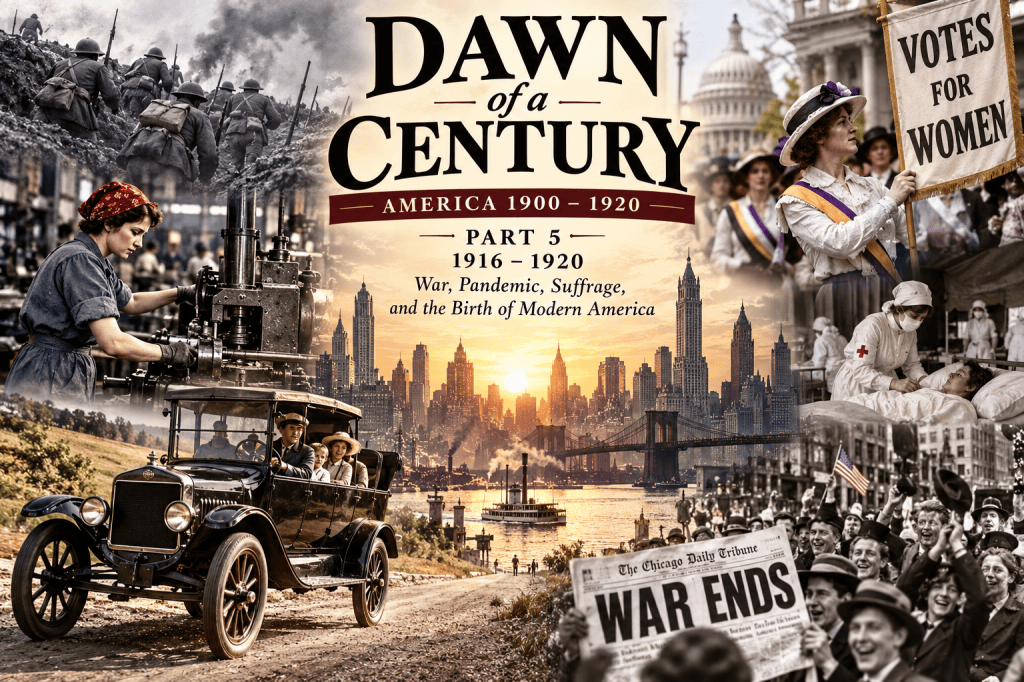
AMERICA, 1900–1920
PART 5
https://fineartamerica.com/featured/dawn-of-a-century-montage-james-inlow.html
1916–1920
War, Pandemic, Suffrage, and the Birth of Modern America
INTRODUCTION
The Final Years of a Transformative Era
By 1916, America stood at the threshold of enormous change.
The country had entered the twentieth century with horses, railroads, gas lamps, farms, factories, and a rapidly growing population.
Now automobiles filled city streets.
Factories were producing goods on an enormous scale.
Motion pictures were becoming a national entertainment.
Telephones connected communities.
Women were demanding the right to vote.
African Americans were moving toward northern cities in search of opportunity.
And across the Atlantic, World War I was consuming Europe.
During the next five years, America would experience some of the most dramatic events in its history.
The United States would enter World War I.
Millions of Americans would be mobilized.
Women would take on new responsibilities.
Factories would work around the clock.
Food conservation would become a patriotic duty.
Millions would buy Liberty Bonds.
The influenza pandemic of 1918 would bring death and disruption into American communities.
The war would end.
Soldiers would return home.
Labor unrest would spread.
Fear of radicalism would contribute to the Red Scare.
Prohibition would begin.
And in 1920, the Nineteenth Amendment would become part of the Constitution.
By the end of 1920, America would be entering a new era.
CHAPTER 1
THE ELECTION OF 1916
The presidential election of 1916 occurred while Europe was deep in World War I.
President Woodrow Wilson sought reelection.
Republicans nominated Charles Evans Hughes.
Wilson campaigned under the theme that the country should remain out of the European war, while also maintaining national preparedness.
Wilson won a second term.
But the war was increasingly affecting American foreign relations.
DAILY LIFE — AMERICANS FOLLOW THE WAR
A family sitting at the breakfast table in 1916 could open the newspaper and read about battles in Europe.
Maps showed the changing fronts.
Photographs showed soldiers, trenches, ships, airplanes, and destroyed towns.
People discussed the war at work, in stores, churches, restaurants, and homes.
For immigrant families, the war could be especially personal.
Relatives might still live in Europe.
A letter from overseas could bring news of a brother, cousin, parent, or friend.
America was officially neutral, but the war was increasingly part of everyday conversation.
CHAPTER 2
AMERICA PREPARES FOR WAR
During 1916 and early 1917, the United States increased military preparedness.
The country was still divided over the question of entering the war.
Some Americans believed the nation should remain neutral.
Others believed American interests and security required greater involvement.
DAILY LIFE — THE MILITARY BECOMES MORE VISIBLE
Military training became more noticeable.
Young men discussed enlistment.
Newspapers carried photographs of soldiers.
Recruiting posters appeared in public places.
Military camps expanded.
Families began thinking about the possibility that sons might eventually be called to serve.
The possibility of war changed conversations around dinner tables.
Parents wondered what might happen to their children.
Young men wondered whether they would volunteer.
The nation was preparing for something that many hoped would never happen.
CHAPTER 3
AMERICA ENTERS WORLD WAR I
In April 1917, the United States entered World War I.
The decision transformed American life.
The federal government rapidly expanded its activities.
The military grew dramatically.
Factories shifted production toward wartime needs.
The United States would send millions of men into military service.
The National Archives notes that federal agencies oversaw wartime production while organizations including the Red Cross, YMCA, and Salvation Army supported the wartime effort on the home front.
DAILY LIFE — THE NEWS ARRIVES
The announcement of war would have been followed through newspapers and public announcements.
People gathered around newspaper offices.
Crowds discussed the news.
Churches held meetings.
Community organizations began organizing support activities.
For families with young men of military age, the war suddenly became much more than something happening in Europe.
It was now America’s war.
CHAPTER 4
SELECTIVE SERVICE
The United States needed a large army.
The Selective Service system became an important mechanism for registering and calling men into military service.
For many young men, military service changed the direction of their lives.
A farm boy could suddenly find himself in a military camp.
A factory worker could become a soldier.
A clerk could become an infantryman.
A college student could become an officer.
DAILY LIFE — THE DRAFT
A registration notice could be one of the most frightening pieces of mail a young man received.
Families gathered around kitchen tables discussing what might happen.
Some men volunteered.
Others waited to learn whether they would be selected.
Training camps introduced young men from different regions and backgrounds to one another.
For some, military service was their first experience traveling far from home.
CHAPTER 5
THE AMERICAN SOLDIER
American soldiers underwent intensive training before being sent overseas.
They learned military discipline, weapons handling, marching, field tactics, and other skills.
Eventually, many crossed the Atlantic aboard troopships.
DAILY LIFE — LEAVING HOME
A soldier’s departure could become an emotional community event.
Families gathered at railroad stations.
Mothers and fathers said goodbye.
Sweethearts exchanged letters and photographs.
Children watched trains carrying soldiers disappear down the tracks.
A family might not know when they would see their son again.
Letters became precious.
A photograph of a soldier in uniform could sit prominently in a family’s home.
For thousands of households, the war created a constant mixture of pride, fear, and uncertainty.
CHAPTER 6
THE HOME FRONT
America’s home front became a vast wartime production system.
Factories produced weapons, ammunition, uniforms, vehicles, ships, food, and other supplies.
The federal government established agencies to coordinate production and mobilize civilian resources.
DAILY LIFE — EVERYONE HAS A JOB
Even people who never wore a uniform could participate in the war effort.
Civilians:
- Bought Liberty Bonds
- Donated to relief organizations
- Conserved food
- Worked in factories
- Volunteered
- Supported soldiers
- Made clothing
- Participated in community drives
The war increasingly became a shared national experience.
CHAPTER 7
WOMEN AND WAR WORK
As men entered military service, women took on additional responsibilities.
Women worked in factories, offices, hospitals, transportation, communications, agriculture, and government-related positions.
The National Archives documents the wartime work of women and the creation of the Women’s Bureau in 1918 to address women’s employment and working conditions.
DAILY LIFE — THE WOMAN WORKER
A woman who had previously worked only inside the home might now find herself operating machinery in a factory.
Another might become a clerk.
Another might work in an office.
Another might volunteer with the Red Cross.
A nurse could care for wounded soldiers.
Women were demonstrating that they could perform jobs previously regarded as men’s work.
The war did not eliminate discrimination or unequal pay.
But it expanded the range of occupations available to many women.
CHAPTER 8
FOOD CONSERVATION
Food became an important part of the wartime effort.
Americans were encouraged to conserve food so that more supplies could be sent to American troops and Allied nations.
DAILY LIFE — THE WAR-TIME KITCHEN
The kitchen became a place of patriotic activity.
Families were encouraged to reduce waste.
Households experimented with substitute ingredients.
Garden plots became important.
Families canned vegetables.
Leftovers were reused.
Children learned that wasting food was considered unpatriotic.
Women played a particularly important role because they managed much of the household food supply.
A dinner table could therefore become part of the national war effort.
CHAPTER 9
LIBERTY BONDS
The government needed enormous amounts of money to finance the war.
Liberty Bonds became a major fundraising mechanism.
Citizens were encouraged to purchase bonds.
DAILY LIFE — BUYING A BOND
A factory worker could purchase a bond from part of his wages.
A shopkeeper could encourage customers to participate.
Schools held patriotic events.
Community organizations promoted bond drives.
Posters encouraged Americans to invest in victory.
For many families, buying a Liberty Bond represented both a financial investment and a patriotic statement.
CHAPTER 10
PROPAGANDA AND PATRIOTISM
The government and private organizations used posters, newspapers, speeches, films, and public campaigns to encourage support for the war.
Patriotic imagery became common.
The American flag appeared everywhere.
Recruiting posters encouraged men to enlist.
Other posters encouraged citizens to conserve food and purchase bonds.
DAILY LIFE — A PATRIOTIC AMERICA
Patriotism could be seen in:
- Parades
- Flags
- School ceremonies
- Public speeches
- Posters
- Community gatherings
- Newspaper editorials
- Fundraising events
Children participated too.
Schools held patriotic exercises.
Students learned songs and poems.
Community events often raised money for the war.
CHAPTER 11
AFRICAN AMERICANS AND WORLD WAR I
African Americans served in the U.S. military during World War I, despite discrimination and segregation within the armed forces.
The war also accelerated migration from the South to northern and Midwestern cities.
DAILY LIFE — THE GREAT MIGRATION CONTINUES
Factories needed workers.
African Americans increasingly traveled north to cities such as:
- Chicago
- Detroit
- Cleveland
- Pittsburgh
- New York
- Philadelphia
Families packed belongings into suitcases and trunks.
Railroad stations became places of transition.
A person leaving the South might be leaving behind generations of family history.
Northern cities offered employment opportunities, but discrimination remained widespread.
Housing segregation, unequal employment opportunities, and racial violence continued.
The migration nevertheless transformed American cities and culture.
CHAPTER 12
THE WAR CHANGES THE WORKPLACE
Industrial production expanded rapidly.
Factories needed workers.
Machines operated for long hours.
Production schedules became increasingly important.
DAILY LIFE — THE FACTORY
A worker might enter the factory before sunrise.
The building could already be filled with noise.
Machines operated continuously.
Workers performed specialized tasks.
Lunch breaks were short.
The factory whistle determined the schedule.
For women entering industrial work, the experience could be completely new.
For men who remained in civilian jobs, overtime could become common.
War production helped accelerate America’s transition to a mass-production economy.
CHAPTER 13
THE AMERICAN FARM
Farmers were essential to the war effort.
Europe needed food.
American soldiers needed food.
Allied nations needed supplies.
DAILY LIFE — THE FARMER IN WARTIME
A farm family might work longer hours to increase production.
Fields had to be planted.
Animals had to be fed.
Harvests had to be collected.
Farm machinery became increasingly important.
Women and children sometimes took on additional agricultural responsibilities when men left for military service.
The farm remained a central part of the American economy.
CHAPTER 14
CHILDREN DURING THE WAR
Children were not soldiers, but the war affected their lives.
DAILY LIFE — THE SCHOOLCHILD
Children participated in patriotic activities.
They learned about the war.
They collected money.
They helped with conservation campaigns.
They participated in community events.
They saw soldiers in uniform.
They watched troop trains.
They heard adults discussing casualty lists and newspaper reports.
For some children, the war was something exciting.
For others, it was frightening.
A child’s father or older brother might be overseas.
The war could therefore become deeply personal.
CHAPTER 15
THE 1918 INFLUENZA PANDEMIC
In 1918, another crisis struck the United States.
Influenza spread rapidly.
The pandemic became especially severe during the fall of 1918.
The CDC’s historical timeline records that the second wave emerged at U.S. military camps in September 1918 and that the second wave was responsible for most of the pandemic’s deaths in the United States.
DAILY LIFE — A SUDDENLY DANGEROUS WORLD
A healthy person could become seriously ill.
Families cared for sick relatives at home.
Doctors and nurses were overwhelmed.
Hospitals struggled with demand.
Communities sought ways to reduce transmission.
In some cities, public gatherings were restricted.
Theaters and movie houses closed in some communities.
Schools and churches were affected.
The CDC records that cities including Chicago and San Francisco implemented restrictions or mask policies during the pandemic.
CHAPTER 16
THE MASKED AMERICA
Masks became a visible part of everyday life in some communities.
Red Cross volunteers made masks.
Workers wore masks.
Public-health officials encouraged protective measures.
DAILY LIFE — GOING TO TOWN
Imagine walking down a city street in October 1918.
A person might see:
- Masked pedestrians
- Masked workers
- Empty theaters
- Closed public gathering places
- Signs warning about influenza
- Nurses traveling to homes
- Doctors making house calls
The pandemic changed ordinary routines.
Even a trip to the barber or grocery store could involve new precautions.
The CDC’s historical image collection documents masked workers, Red Cross volunteers, pharmacists, nurses, and other community responses.
CHAPTER 17
FAMILIES DURING THE PANDEMIC
Families faced difficult choices.
A sick family member might need to be isolated.
Relatives cared for one another.
Neighbors brought food.
Volunteers helped families who were unable to shop or work.
DAILY LIFE — CARING FOR THE SICK
Home nursing was extremely important.
Someone had to:
- Prepare food
- Bring water
- Wash clothing
- Monitor the sick
- Care for children
- Contact a doctor
- Clean the home
A household could become overwhelmed if several people became ill simultaneously.
Some families lost multiple relatives.
The pandemic left emotional scars that would last for years.
CHAPTER 18
THE END OF WORLD WAR I
On November 11, 1918, the fighting stopped with the Armistice.
The news produced enormous celebrations across the United States.
DAILY LIFE — ARMISTICE DAY
People poured into streets.
Church bells rang.
Factory whistles sounded.
Flags appeared everywhere.
Crowds celebrated.
People hugged strangers.
Newspapers published enormous headlines.
For families with soldiers overseas, the celebration carried a second emotion:
relief.
The fighting was over.
But thousands of soldiers still had to return home.
And the influenza pandemic was still raging.
The CDC notes that the end of the war and returning soldiers contributed to renewed influenza spread.
CHAPTER 19
BRINGING THE SOLDIERS HOME
The end of combat did not mean an immediate return to normal life.
Soldiers had to be transported home.
Military units were demobilized.
Families waited.
DAILY LIFE — THE RETURNING SOLDIER
A returning soldier might arrive at a railroad station wearing his uniform.
His family might have waited months or years.
Children might barely remember their father.
A wife might have changed dramatically during his absence.
The soldier himself had changed.
He had experienced military discipline, foreign countries, battlefield conditions, and the deaths of friends.
Returning home could therefore be both joyful and difficult.
CHAPTER 20
AMERICA AFTER THE WAR
The United States emerged from World War I as a major international power.
American industry had expanded.
American agriculture had supplied enormous quantities of food.
The United States had become a major creditor nation.
But Americans also wanted to return to normal life.
DAILY LIFE — GETTING BACK TO NORMAL
Factories shifted away from wartime production.
Soldiers looked for jobs.
Families wanted peace.
People wanted entertainment.
Consumers wanted automobiles, clothing, appliances, and other goods.
Young Americans increasingly looked toward a different future.
The culture of the 1920s was beginning to form.
CHAPTER 21
THE TREATY OF VERSAILLES
President Wilson traveled to Europe to participate in the peace negotiations.
The Treaty of Versailles formally ended the state of war between Germany and the Allied powers.
Wilson strongly supported the creation of a League of Nations.
The treaty became controversial in the United States.
The Senate debated whether the United States should ratify it.
DAILY LIFE — THE PEACE DEBATE
Americans followed the controversy through newspapers.
Political arguments continued.
Some Americans supported Wilson’s international vision.
Others feared permanent foreign entanglements.
The debate became one of the most important political controversies of the postwar period.
CHAPTER 22
THE RED SCARE
After the war, fear of radical political movements increased.
The Russian Revolution and labor unrest contributed to fears of communism and radicalism.
In 1919 and 1920, government authorities conducted raids against suspected radicals.
DAILY LIFE — FEAR AND UNCERTAINTY
Newspapers reported strikes, bombings, arrests, and political unrest.
Immigrants sometimes faced suspicion.
Workers feared being accused of radicalism.
Employers feared strikes.
Government officials feared revolutionary activity.
The atmosphere was tense.
The United States was experiencing a period of political anxiety.
CHAPTER 23
LABOR UNREST
After the war, labor tensions increased.
Workers sought higher wages and better conditions.
Employers sought to maintain control over production.
Major strikes occurred in several industries.
DAILY LIFE — THE WORKING FAMILY
Inflation affected household budgets.
The cost of food and other necessities could rise.
Workers wanted wages that kept pace.
A strike could mean no paycheck.
Families had to decide how long they could survive without income.
Workers sometimes received support from unions and neighbors.
Labor disputes could divide entire communities.
The industrial economy was becoming increasingly powerful—but so were organized workers.
CHAPTER 24
PROHIBITION
The temperance movement had been active for decades.
The Eighteenth Amendment was ratified in 1919 and Prohibition took effect in January 1920.
The Volstead Act established federal enforcement mechanisms.
DAILY LIFE — AMERICA GOES DRY
The change affected restaurants, saloons, breweries, families, and communities.
Some people welcomed Prohibition.
Others opposed it.
Some businesses closed.
Others attempted to adapt.
Illegal alcohol sales developed.
Secret drinking establishments would eventually become associated with the 1920s.
Prohibition became one of the most controversial social experiments in American history.
CHAPTER 25
WOMEN WIN THE VOTE
The struggle for women’s suffrage reached its constitutional conclusion in 1920.
Congress passed the proposed amendment in 1919.
Tennessee became the 36th state to ratify it on August 18, 1920.
The Nineteenth Amendment was certified on August 26, 1920.
DAILY LIFE — A NEW POLITICAL WORLD
For women who had spent decades campaigning for suffrage, the change was historic.
Women registered to vote.
Political organizations began educating new voters.
Candidates increasingly had to consider women as part of the electorate.
The National American Woman Suffrage Association transitioned into the League of Women Voters in 1920, emphasizing political education and participation.
But the amendment did not instantly eliminate all barriers.
Discriminatory laws and practices continued to prevent many women, especially many women of color, from fully exercising voting rights.
CHAPTER 26
THE AUTOMOBILE BOOM
By 1920, automobiles were becoming a central part of American life.
Ford’s Model T remained one of the most recognizable automobiles in America.
DAILY LIFE — LIFE ON THE ROAD
A family with a car could travel on its own schedule.
Sunday drives became increasingly popular.
Families visited relatives.
People traveled to parks and countryside destinations.
Farmers transported goods.
Salesmen traveled between towns.
Doctors could reach patients faster.
The automobile encouraged the development of:
- Gas stations
- Repair shops
- Tire businesses
- Roadside stores
- Restaurants
- Tourist accommodations
America was beginning to organize itself around the automobile.
CHAPTER 27
THE MODERN CONSUMER
Mass production meant that Americans could purchase increasingly large quantities of manufactured goods.
Products included:
- Automobiles
- Clothing
- Furniture
- Phonographs
- Sewing machines
- Kitchen equipment
- Bicycles
- Radios and radio-related equipment
- Household products
DAILY LIFE — SHOPPING
Department stores became major destinations.
A woman could spend hours browsing clothing, household goods, cosmetics, and other merchandise.
Mail-order catalogs remained important for rural families.
Advertising became increasingly sophisticated.
Newspapers and magazines encouraged consumers to purchase new products.
The American economy was shifting toward mass consumption.
CHAPTER 28
THE PHONOGRAPH AND POPULAR MUSIC
The phonograph became an increasingly important part of home entertainment.
Families could purchase records and play music in their homes.
DAILY LIFE — MUSIC AT HOME
An evening might include:
- A phonograph record
- Piano playing
- Singing
- Dancing
- Card games
- Reading
Music was becoming increasingly commercial.
Popular songs could spread quickly through sheet music and recordings.
African American musical traditions were increasingly influencing American popular culture.
The musical revolution of the 1920s was already underway.
CHAPTER 29
MOTION PICTURES
Movies had become a major form of entertainment.
Hollywood was growing.
Film stars became celebrities.
DAILY LIFE — A NIGHT AT THE MOVIES
A young couple could go to a theater for an evening of entertainment.
Families could take children.
Friends could meet at the theater.
Silent films were accompanied by music.
Movie theaters offered audiences an escape from work and everyday worries.
The motion-picture industry would become one of America’s most influential cultural institutions.
CHAPTER 30
RADIO BEGINS TO CHANGE AMERICA
By 1920, radio was beginning to emerge as a new technology.
It was not yet the universal household entertainment system it would become later in the 1920s.
But experiments in broadcasting were creating the foundation for a revolutionary new form of communication.
DAILY LIFE — THE BEGINNING OF A NEW ERA
Imagine a household in 1920 hearing a broadcast through a new radio receiver.
For the first time, entertainment and information could potentially enter the home electronically.
The technology was still young.
But its potential was enormous.
The age of mass electronic communication was beginning.
CHAPTER 31
THE AMERICAN HOME IN 1920
The home of 1920 could look surprisingly modern.
Some households had:
- Electricity
- Telephones
- Indoor plumbing
- Automobiles
- Phonographs
- Manufactured furniture
- Gas or electric appliances
But many rural homes still lacked electricity and indoor plumbing.
DAILY LIFE — TWO AMERICAS
A wealthy urban family might live in a modern house or apartment.
A rural family might still depend upon:
- Kerosene
- Wood stoves
- Hand pumps
- Horses
- Outhouses
- Gardens
- Home preservation of food
America was modernizing, but modernization remained uneven.
CHAPTER 32
CHILDHOOD IN 1920
Children experienced a world different from their parents’ childhood.
Automobiles were becoming familiar.
Movies provided new entertainment.
Schools were increasingly common.
Cities offered amusement parks, theaters, and recreational activities.
DAILY LIFE — PLAY
Children played:
- Baseball
- Football
- Marbles
- Tag
- Hide-and-seek
- Jump rope
- Board games
- Card games
Many children spent much of their free time outdoors.
Neighborhoods were important social environments.
Children often knew the families living nearby.
CHAPTER 33
CLOTHING IN 1920
Fashion was changing.
Women were beginning to wear clothing that was less restrictive than the fashions of the early 1900s.
Men’s clothing remained relatively formal.
DAILY LIFE — GETTING DRESSED
A man going to work might wear a suit and hat.
A factory worker wore practical work clothes.
Women wore dresses, skirts, blouses, coats, and hats.
Clothing remained relatively expensive compared with modern mass-produced garments.
Families repaired and reused clothing.
The dramatic fashion changes associated with the later 1920s were beginning to appear.
CHAPTER 34
FOOD IN 1920
The American diet was changing.
Mass-produced foods were becoming increasingly common.
Canned goods were widely available.
Bakeries and grocery stores offered more manufactured products.
DAILY LIFE — THE AMERICAN TABLE
A family might eat:
Breakfast
Eggs, bacon, toast, oatmeal, fruit, coffee, or milk.
Lunch
Sandwiches, soup, leftovers, fruit, or a meal purchased near work.
Dinner
Meat, potatoes, vegetables, bread, and dessert.
Rural families still produced much of their own food.
Urban families depended increasingly on stores and commercial food suppliers.
CHAPTER 35
THE AMERICAN CITY IN 1920
Cities had changed dramatically since 1900.
Skyscrapers rose above streets.
Streetcars carried commuters.
Automobiles shared the roads with horses.
Factories employed thousands.
Department stores attracted shoppers.
Movie theaters filled evenings.
DAILY LIFE — THE CITY STREET
A walk through a major city in 1920 might include:
- Streetcars
- Automobiles
- Horse-drawn wagons
- Delivery trucks
- Newspaper sellers
- Department stores
- Restaurants
- Movie theaters
- Office buildings
- Factories
- Crowded sidewalks
The modern American city had arrived.
CHAPTER 36
THE RURAL AMERICAN COMMUNITY IN 1920
Rural America remained enormously important.
Farmers produced food and raw materials.
Small towns served surrounding agricultural communities.
DAILY LIFE — SMALL-TOWN AMERICA
A small town might have:
- General store
- Bank
- Post office
- Church
- School
- Blacksmith or mechanic
- Doctor
- Newspaper office
- Barber shop
- Grocery store
The town could be the center of social life for miles around.
Saturday might be the busiest day.
Farmers came into town to sell products, purchase supplies, visit friends, collect mail, and conduct business.
CHAPTER 37
AMERICA’S CHANGING COMMUNITIES
Between 1900 and 1920, millions of Americans moved.
People moved:
- From farms to cities
- From the South to the North
- From small towns to large cities
- From rural areas to industrial centers
- From Europe to American cities
Communities became increasingly diverse.
DAILY LIFE — THE IMMIGRANT NEIGHBORHOOD
A neighborhood could contain people from many countries.
Different languages could be heard on the streets.
Restaurants offered ethnic foods.
Churches and synagogues served community needs.
Newspapers were published in immigrant languages.
Children often moved between two cultures—home and school.
American identity was becoming increasingly diverse.
CHAPTER 38
1919–1920 — A COUNTRY IN TRANSITION
The years immediately after the war were difficult.
America faced:
- Inflation
- Labor unrest
- Political conflict
- Racial tensions
- Fear of radicalism
- Prohibition
- Social change
Yet the economy was also moving toward a new consumer age.
DAILY LIFE — LOOKING FORWARD
People wanted new homes.
They wanted automobiles.
They wanted entertainment.
They wanted better wages.
They wanted peace.
Young Americans were increasingly interested in new forms of music, fashion, movies, and social life.
The generation that would define the 1920s was coming of age.
CHAPTER 39
AMERICA IN 1920
By 1920, the transformation that had begun around 1900 was unmistakable.
America was now:
An industrial power.
An automobile nation.
A mass-production economy.
A major world power.
A consumer society.
A country with a growing entertainment industry.
A nation whose women had gained a constitutional voting right.
A society increasingly shaped by cities.
But enormous problems remained.
Racial discrimination continued.
Economic inequality remained.
Labor conflicts continued.
Farmers faced serious economic challenges.
Immigrants faced discrimination.
Prohibition created new conflicts.
The country was divided over America’s role in the world.
The future was uncertain.
A DAY IN AMERICA — 1920
Imagine waking up in an American home in 1920.
The morning newspaper arrives.
The household begins its daily routine.
Breakfast is prepared.
Children get ready for school.
A worker walks to a streetcar or climbs into an automobile.
A farmer begins work in the fields.
A factory worker enters a massive industrial plant.
A woman goes to an office, store, school, factory, or hospital—or remains home managing the household.
The telephone rings.
The mail arrives.
Stores open.
Automobiles fill the streets.
At lunchtime, workers gather in restaurants, lunchrooms, or factory cafeterias.
Children return from school.
Farmers finish afternoon chores.
In the evening, families gather around the dinner table.
Some listen to a phonograph.
Some read.
Some go to the movies.
Some attend church.
Some visit neighbors.
Some take the automobile out for an evening drive.
And increasingly, Americans are looking toward a new form of entertainment and communication:
radio.
The nineteenth century is gone.
The twentieth century has arrived.
AMERICA’S GREAT TRANSFORMATION
1900–1920
Looking back across the entire twenty-year period reveals an extraordinary transformation.
1900
Horse-drawn transportation dominated.
Electricity was limited.
Most Americans lived much closer to the land.
Women could not vote nationally.
Industrialization was expanding.
1910
Automobiles were becoming more common.
Cities were growing.
Motion pictures were becoming popular.
Progressive reform was increasingly influential.
1915
Mass production was transforming factories.
Automobiles were changing transportation.
The Panama Canal had opened.
Europe was at war.
1918
America was fighting a world war.
Women were working in new industries.
The influenza pandemic devastated communities.
1920
Women gained constitutional protection against denial of voting rights on account of sex.
Prohibition began.
Automobiles were becoming central to American life.
Mass consumer culture was expanding.
Radio was beginning its transformation of American communication.
The country was entering a completely new era.
FINAL CHAPTER
THE END OF AN ERA
The America of 1920 was not the America of 1900.
In twenty years, the nation had experienced:
Industrial expansion
Mass production
Progressive reform
The automobile revolution
The rise of motion pictures
The expansion of consumer culture
The Great Migration
World War I
The influenza pandemic
Labor unrest
Prohibition
Women’s suffrage
And countless changes in ordinary daily life.
The family kitchen was changing.
The workplace was changing.
The city street was changing.
The farm was changing.
The way Americans traveled was changing.
The way they communicated was changing.
The way they entertained themselves was changing.
The role of women was changing.
The relationship between government and citizens was changing.
America had entered 1900 looking toward the future.
It entered 1920 living in the future.
EPILOGUE
The Doorway to the Roaring Twenties
The final months of 1920 brought a sense that something new was beginning.
Young Americans had grown up with automobiles and movies.
Businesses were learning how to sell to a national consumer market.
Factories had mastered mass production.
Women were entering the electorate.
African American communities were transforming northern cities.
Jazz was developing rapidly.
Movies were becoming a dominant cultural force.
Radio was beginning to emerge.
The automobile was changing the landscape.
The old Victorian world was fading.
The new American century was beginning.
The next chapter would be the Roaring Twenties.
But the foundation for that decade had been built during the twenty years between 1900 and 1920.
PART 5 TIMELINE
1916–1920
1916
- Presidential election between Woodrow Wilson and Charles Evans Hughes.
- World War I continues in Europe.
- American preparedness increases.
- Women’s suffrage expands in additional states.
1917
- United States enters World War I.
- Military mobilization begins.
- Selective Service expands the Army.
- American industry shifts toward wartime production.
1918
- Millions of American soldiers serve in the war.
- The influenza pandemic spreads across the United States.
- Armistice ends World War I on November 11.
1919
- Treaty of Versailles is signed.
- The U.S. Senate debates the treaty and League of Nations.
- Labor strikes increase.
- Red Scare intensifies.
- Nineteenth Amendment is passed by Congress.
- Prohibition amendment is ratified.
1920
- Prohibition begins.
- Nineteenth Amendment is ratified.
- Women gain constitutional protection against voting discrimination based on sex.
- Warren G. Harding wins the presidential election.
- America enters a new decade.
THE AMERICA OF 1920
Population: rapidly urbanizing and increasingly diverse.
Transportation: automobile, railroad, streetcar, bicycle, and steamship.
Communication: newspaper, telephone, telegraph, mail, and emerging radio.
Entertainment: movies, phonographs, music, baseball, vaudeville, theater, and community events.
Work: factories, offices, farms, stores, mines, railroads, and growing professional occupations.
Home: increasingly electrified in cities, while many rural homes continued using older technologies.
Politics: transformed by World War I, Progressivism, women’s suffrage, Prohibition, labor unrest, and debates over America’s international role.
Culture: moving toward the Jazz Age.
CONCLUSION
1900–1920: Twenty Years That Changed America
The years between 1900 and 1920 were more than a period of political and technological change.
They were a transformation of everyday life.
The automobile changed where people could go.
The telephone changed how they communicated.
Electricity changed the home.
The factory changed how they worked.
Mass production changed what they could buy.
Movies changed how they spent their evenings.
The Great Migration changed where millions of Americans lived.
World War I changed America’s relationship with the world.
The influenza pandemic changed how communities thought about public health.
Women’s suffrage changed the American electorate.
And by 1920, an entirely new generation was ready to enter the decade that would become known as the Roaring Twenties.
The America that entered the 1920s was faster, more industrial, more urban, more consumer-oriented, and more connected than the America of 1900.
Yet it still carried many of the old nation’s problems.
The story was not finished.
In many ways, it was only beginning.
END OF PART 5
AMERICA, 1900–1920
A Twenty-Year Journey from the Old America to the Modern Age

https://fineartamerica.com/featured/early-20th-century-american-scenes-james-inlow.html


Leave a comment