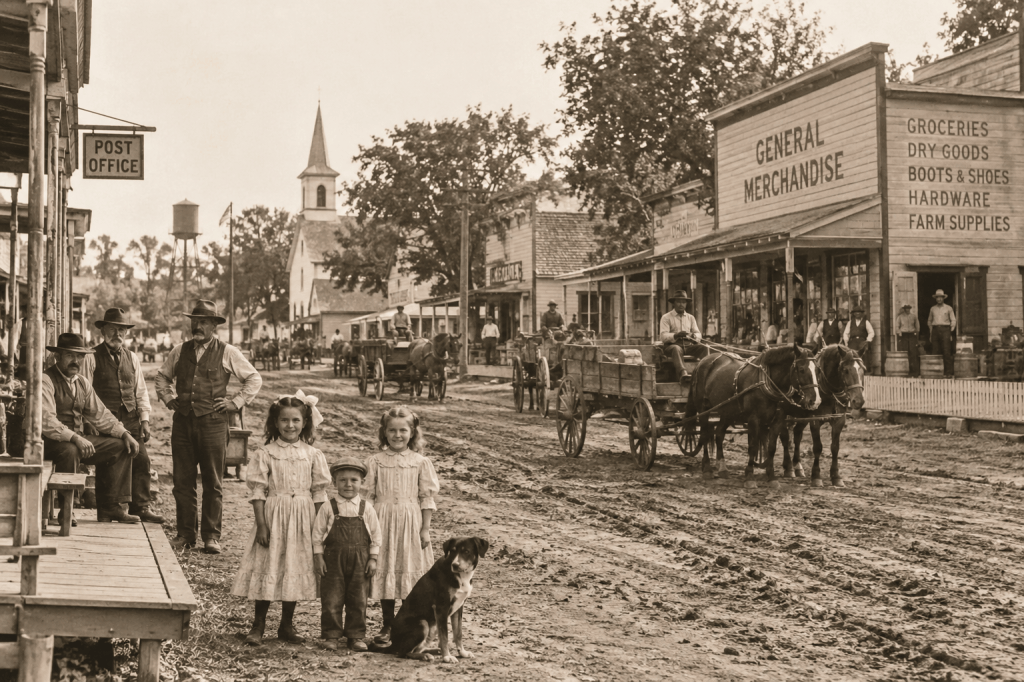
https://lanternstreets.com/featured/small-town-life-in-the-1900s-james-inlow.html
America, 1900–1920
Day 2 — The Age of Reform and Expansion, 1904–1907
America Moves Deeper Into the Twentieth Century
By 1904, the United States had entered a period of extraordinary change.
The country was becoming an industrial powerhouse. Cities were growing upward and outward. Immigrants continued arriving by the millions. Automobiles were beginning to appear on American streets, motion pictures were attracting curious audiences, and factories were producing goods on a scale previous generations could scarcely have imagined.
At the center of this rapidly changing nation stood President Theodore Roosevelt.
Roosevelt’s presidency reflected the energy, confidence, and contradictions of the age. He wanted America to become a stronger nation, but he also believed government needed to respond to the problems created by industrialization.
Between 1904 and 1907, Americans would see the beginnings of the Panama Canal, a growing national conservation movement, major labor conflicts, new consumer products, the expansion of cities, and increasing demands for reform.
The United States was becoming modern.
Chapter 1
Theodore Roosevelt and the Election of 1904
Theodore Roosevelt entered the 1904 presidential campaign as an increasingly popular national figure.
After becoming president following William McKinley’s assassination, Roosevelt had demonstrated that he intended to use the presidency actively.
He supported regulation of large corporations, conservation of natural resources, and federal involvement in certain labor disputes.
In the 1904 election, Roosevelt ran for a full presidential term.
His opponent was Democrat Alton B. Parker.
Roosevelt won decisively.
The election demonstrated the growing importance of the presidency as a national institution and confirmed Roosevelt as one of the dominant political figures of the Progressive Era.
But Roosevelt’s ambitions extended beyond domestic reform.
He believed the United States needed to play a major role in world affairs.
Chapter 2
America Looks Toward the World
The United States had emerged from the Spanish-American War of 1898 with greater international influence.
American territories and interests stretched into the Caribbean and Pacific.
The Philippines remained under American control, while Puerto Rico and Guam had also become American territories.
The United States was increasingly interested in trade and strategic influence in the Pacific.
Japan was also emerging as a major power.
In 1904, Japan went to war with Russia.
The conflict became one of the most important international events of the decade.
Roosevelt eventually helped negotiate peace between the two countries.
For his role in the negotiations, Roosevelt received the Nobel Peace Prize in 1906.
It was the first time an American president had received the prize.
Chapter 3
The Panama Canal
Few projects represented America’s growing international ambitions more dramatically than the Panama Canal.
A canal across Central America would connect the Atlantic and Pacific Oceans and dramatically shorten sea routes.
The United States supported Panama’s independence from Colombia in 1903 and subsequently obtained rights to build and operate a canal across the Panama Canal Zone.
Construction was an enormous undertaking.
Workers had to cut through mountains, control disease, move millions of cubic yards of earth, and create a massive system of locks.
Yellow fever and malaria posed serious dangers.
American doctors and sanitation workers eventually made major progress controlling the diseases.
The canal would not open until 1914, but during 1904–1907 construction became one of the great engineering projects of the era.
Chapter 4
The Rise of the Automobile
The automobile was still a relatively new invention, but its future was becoming increasingly obvious.
Cars were expensive.
Roads were poor.
Gasoline was not yet readily available everywhere.
Mechanical problems were common.
Yet Americans were fascinated by automobiles.
Manufacturers competed to make cars faster, safer, and more reliable.
In 1903, Henry Ford had established the Ford Motor Company.
During the following years, Ford worked toward a revolutionary goal:
Build a dependable automobile that ordinary Americans could eventually afford.
The famous Model T would not appear until 1908, but the foundations of the automobile revolution were being laid during these years.
The automobile promised something completely different from the railroad.
A railroad followed tracks.
An automobile could go almost anywhere there was a road.
That simple difference would eventually transform American life.
Chapter 5
The Changing American City
American cities were becoming larger and more crowded.
New York, Chicago, Boston, Philadelphia, St. Louis, and other major cities attracted workers from rural America and immigrants from around the world.
Skyscrapers were changing city skylines.
Electric streetcars allowed people to travel farther from their workplaces.
Department stores were becoming major centers of shopping.
Advertising encouraged Americans to purchase products they had never previously considered necessary.
But rapid growth brought serious problems.
Tenement housing could be overcrowded.
Sanitation systems were often inadequate.
Air pollution from coal and factories darkened city skies.
Traffic became increasingly difficult to manage.
City governments struggled to keep pace with population growth.
The modern American city was being created—but it was often chaotic and unhealthy.
Chapter 6
The Department Store and the New Consumer
Shopping was changing.
Large department stores offered an enormous variety of merchandise under one roof.
Stores such as Macy’s and other major retailers became destinations rather than simply places to purchase necessities.
Customers could browse clothing, furniture, household goods, toys, cosmetics, appliances, and countless other products.
Advertising became increasingly sophisticated.
Newspapers and magazines carried advertisements promising Americans better homes, better clothing, better health, and easier lives.
Mail-order catalogs also brought consumer goods to rural families.
Companies such as Sears, Roebuck and Co. allowed customers far from major cities to order products through the mail.
America was becoming a consumer society.
Chapter 7
Upton Sinclair and the Meatpacking Industry
One of the most influential books of the Progressive Era appeared in 1906.
Upton Sinclair published The Jungle, a novel depicting the brutal conditions experienced by immigrant workers in Chicago’s meatpacking industry.
Sinclair intended to expose the exploitation of workers.
However, the book’s descriptions of unsanitary food-processing conditions captured enormous public attention.
Americans became concerned about the safety of the meat they purchased.
The controversy helped generate support for federal food-safety legislation.
In 1906, Congress passed the Meat Inspection Act and the Pure Food and Drug Act.
The federal government was taking a larger role in protecting consumers.
Chapter 8
The Progressive Movement Grows
Progressivism was becoming one of the most important reform movements in American life.
Progressives came from many different backgrounds.
Some were journalists.
Others were lawyers, teachers, ministers, social workers, businesspeople, politicians, or concerned citizens.
They did not always agree with one another.
But many believed that government could be used to address problems caused by industrialization and urbanization.
Their concerns included:
- Unsafe food
- Child labor
- Political corruption
- Poor housing
- Dangerous factories
- Corporate monopolies
- Public health
- Conservation
- Women’s suffrage
- Labor conditions
The movement would become increasingly influential during the years ahead.
Chapter 9
The Conservation Movement
The United States possessed enormous forests, rivers, grasslands, and mineral resources.
But industrialization was consuming these resources rapidly.
Forests were being cleared.
Wildlife populations were declining.
Mining damaged landscapes.
Rivers were increasingly affected by industrial development.
Theodore Roosevelt became one of the nation’s most prominent conservation presidents.
Working with figures such as Gifford Pinchot, Roosevelt expanded federal protection of public lands and encouraged scientific management of natural resources.
National forests, wildlife refuges, and protected lands became important parts of the federal conservation system.
Roosevelt believed America’s natural resources should be used—but also protected for future generations.
Chapter 10
The Great San Francisco Earthquake
On April 18, 1906, a devastating earthquake struck San Francisco, California.
The earthquake and resulting fires destroyed large sections of the city.
Thousands of buildings were damaged or destroyed.
Many people were killed, injured, or left homeless.
The disaster became one of the most famous catastrophes in American history.
San Francisco eventually rebuilt.
The reconstruction demonstrated both the vulnerability of growing American cities and their ability to recover from disaster.
The earthquake also contributed to a greater understanding of earthquake risks and urban construction.
Chapter 11
Labor and the Industrial Worker
Industrial workers continued to struggle for better wages and working conditions.
Factories, mines, mills, railroads, and construction sites could be dangerous places.
Workers sometimes organized strikes to demand improvements.
Employers often viewed unions as threats to their businesses.
The federal government occasionally intervened in labor disputes.
The relationship between labor and government was changing, but workers still faced major challenges.
The issue of how much power workers should have in America’s industrial economy would remain unresolved for decades.
Chapter 12
Women and Reform
Women played an increasingly important role in Progressive reform.
Many women worked through settlement houses, churches, civic organizations, charities, schools, and reform campaigns.
They fought for:
- Better sanitation
- Improved education
- Child welfare
- Public health
- Safer workplaces
- Restrictions on child labor
- Temperance
- Women’s suffrage
Settlement houses became important centers of reform.
One of the most famous was Hull House in Chicago, founded by Jane Addams and Ellen Gates Starr.
These organizations often served immigrant communities and provided education, childcare, social services, and assistance to families.
Women were increasingly demonstrating that they could play major roles in public affairs—even though they still lacked full political rights.
Chapter 13
African Americans and the Struggle for Equality
African Americans continued to face severe discrimination during these years.
Segregation was deeply entrenched in the South.
Voting restrictions prevented many Black Americans from participating fully in political life.
Racial violence remained a serious threat.
Yet African American communities continued to organize and build institutions.
Schools, churches, businesses, newspapers, colleges, and civic organizations provided foundations for community life.
Two important voices represented different approaches to racial advancement.
Booker T. Washington emphasized education, vocational training, economic advancement, and institution building.
W. E. B. Du Bois argued more strongly for immediate civil and political rights.
Their differing approaches reflected a larger debate about how African Americans should fight discrimination and pursue equality.
Chapter 14
The Birth of a New Civil Rights Organization
The racial violence and discrimination of the early twentieth century eventually helped lead to the formation of a new national organization.
In 1905, W. E. B. Du Bois and other activists organized the Niagara Movement.
The movement demanded full civil and political rights for African Americans.
In 1908, racial violence in Springfield, Illinois, would contribute to the creation of the National Association for the Advancement of Colored People—the NAACP.
The organization would become one of the most important civil rights organizations in American history.
The struggle for equality was entering a new phase.
Chapter 15
Children at Work
Child labor remained widespread.
Children worked in textile mills, mines, factories, farms, stores, and other workplaces.
Some were only a few years older than today’s elementary school children.
Families often depended on children’s earnings.
Reformers argued that children should be in school rather than working long hours in dangerous environments.
Photographer Lewis Hine would soon become famous for documenting child labor conditions.
His photographs would provide powerful visual evidence for reformers.
The campaign against child labor would continue for years.
Chapter 16
Entertainment in the New Century
Americans had more entertainment choices than previous generations.
Vaudeville theaters offered variety performances featuring comedians, singers, dancers, magicians, acrobats, and other performers.
Baseball was becoming a major national pastime.
Boxing attracted large audiences.
Circuses continued to travel from town to town.
And motion pictures were becoming increasingly popular.
Movie theaters would eventually become an important part of American urban life.
The entertainment industry was beginning to become a major business.
Chapter 17
The Home Begins to Change
Technology was slowly entering American homes.
Electric lights were replacing candles and kerosene lamps in some communities.
Indoor plumbing was becoming more common in cities.
Telephones were spreading.
New household products promised to reduce the amount of labor required to maintain a home.
But these conveniences were far from universal.
Millions of Americans still depended on traditional methods of cooking, heating, washing, cleaning, and transportation.
The modern home was emerging gradually.
Chapter 18
Rural America
Despite the rapid growth of cities, America remained heavily connected to agriculture.
Farmers produced wheat, corn, cotton, livestock, dairy products, fruits, and vegetables.
Farm families often worked from sunrise to sunset.
The introduction of new farm machinery helped reduce some of the physical labor involved in agriculture.
Railroads allowed farmers to ship their products to distant markets.
Rural communities developed their own schools, churches, stores, social clubs, newspapers, and traditions.
The contrast between rural and urban America would remain an important feature of American life.
Chapter 19
The World in 1907
By 1907, America had become a major industrial and international power.
But the country also experienced a serious financial crisis.
The Panic of 1907 began after financial problems and a failed attempt to corner the stock of a major copper company.
Banks and financial institutions faced pressure.
Depositors rushed to withdraw money.
The crisis threatened the stability of the financial system.
J. Pierpont Morgan, one of America’s most powerful financiers, played a major role in organizing private efforts to stabilize the banking system.
The crisis demonstrated the weaknesses of America’s financial system.
It would eventually contribute to the movement for the creation of a central banking system.
Chapter 20
America in 1907: A Nation in Transition
At the end of 1907, Americans were living in a country that would have seemed almost unimaginable to people living in 1800.
Factories produced goods on a massive scale.
Cities reached upward with skyscrapers.
Electricity was transforming businesses and homes.
Telephones connected people over increasing distances.
Automobiles were appearing on streets.
Motion pictures entertained growing audiences.
Airplanes had moved from dreams into reality.
The federal government was becoming more involved in regulating business and protecting consumers.
Women were demanding a larger role in public life.
African Americans were organizing against racial discrimination.
Workers were demanding greater rights.
America was also becoming a more powerful force in world affairs.
But enormous problems remained.
Poverty had not disappeared.
Racial injustice remained deeply rooted.
Industrial workers faced dangerous conditions.
Children still worked in factories.
Women still lacked nationwide voting rights.
Cities struggled with overcrowding and poor sanitation.
And the nation’s financial system remained vulnerable.
America was modernizing—but modernization brought new problems along with new opportunities.
Timeline: 1904–1907
1904
- Theodore Roosevelt wins election to a full presidential term.
- The Russo-Japanese War begins.
- Construction of the Panama Canal begins under American control.
1905
- The Industrial Workers of the World is founded.
- The Niagara Movement is organized by W. E. B. Du Bois and others.
- The Russo-Japanese War ends with negotiations assisted by Theodore Roosevelt.
1906
- The San Francisco earthquake and fires devastate much of the city.
- Upton Sinclair publishes The Jungle.
- Congress passes the Meat Inspection Act.
- Congress passes the Pure Food and Drug Act.
- Roosevelt receives the Nobel Peace Prize.
1907
- The Panic of 1907 creates a major financial crisis.
- Theodore Roosevelt remains a dominant figure in national politics.
- Industrialization, immigration, urbanization, and Progressive reform continue reshaping American life.
The America of 1907
America in 1907 was a nation caught between the past and the future.
A farmer could still plow a field with horses while, hundreds of miles away, factory workers operated sophisticated machinery.
A family might receive news through a telegraph while watching an automobile pass outside their home.
A child could spend the morning working in a factory and the evening listening to a phonograph.
A woman might work in a settlement house while campaigning for the right to vote.
A newly arrived immigrant might live in a crowded city tenement while dreaming of owning a home.
And a young entrepreneur might look at the automobile and see an entirely new future.
The twentieth century was no longer approaching.
It had arrived.
Looking Ahead: Part 3 — 1908–1911
The next chapter will enter an even more transformative period.
We will follow the arrival of the Ford Model T, the growth of mass production, William Howard Taft’s presidency, the continuing fight for women’s suffrage, the expansion of the telephone and motion pictures, the rise of aviation, immigration, labor struggles, racial tensions, and the terrible Triangle Shirtwaist Factory fire of 1911.
The America that entered 1908 was changing rapidly.
By the end of 1911, it would be changing even faster.


Leave a comment