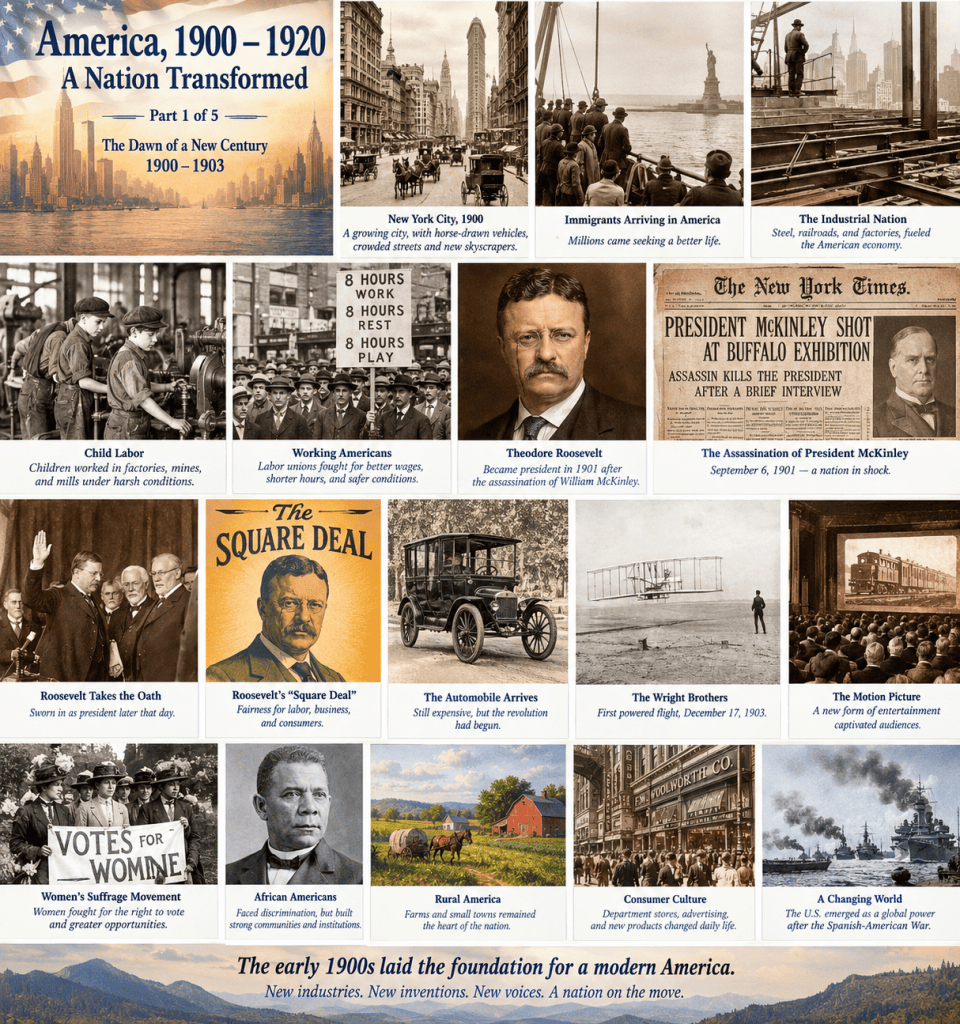
America, 1900–1920
Part 1 of 5: The Dawn of a New Century, 1900–1903
Introduction: A New Century Begins
When Americans celebrated 1900, they stood at the threshold of a new era. The United States had expanded across the continent, connected distant communities through railroads, transformed cities through industrialization, and welcomed millions of immigrants. Yet the country still relied heavily on horses, steam-powered railroads, coal, and wood. Automobiles were rare, airplanes experimental, radio nonexistent, and electricity unevenly distributed.
The years from 1900 to 1920 would bring automobiles, airplanes, motion pictures, mass advertising, consumer culture, powerful corporations, organized labor, women’s suffrage, and new political reforms. They would also bring industrial disasters, racial violence, political upheaval, world war, and the influenza pandemic.
The story begins in 1900.
Chapter 1
https://lanternstreets.com/featured/bustling-19th-century-street-scene-james-inlow.html
America at the Turn of the Century
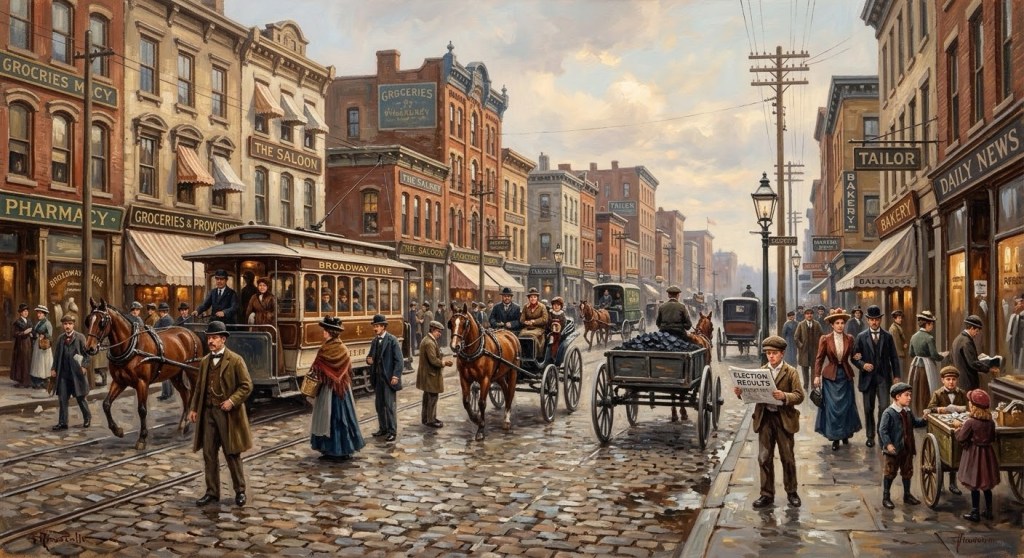
In 1900, the United States had roughly 76 million people. It was already an industrial power, but it remained a nation of sharp contrasts. Cities such as New York, Chicago, Philadelphia, Boston, and St. Louis were expanding rapidly, with factories, skyscrapers, department stores, and mail-order catalogs reshaping urban life. At the same time, millions of Americans lived in rural communities and worked on farms.
Many households still relied on coal- or wood-burning stoves, horse-drawn transportation, and local stores. Electricity was spreading through cities but remained uncommon in rural areas.
A Changing Population
Immigration continued to transform American cities. New arrivals from southern and eastern Europe—including Italians, Poles, Russians, Austrians, Hungarians, and Greeks—joined earlier Irish, German, Scandinavian, and British communities. Immigrants often settled in ethnic neighborhoods with their own languages, churches, newspapers, restaurants, and social organizations.
Urban life offered opportunity but also hardship. Crowded tenements, low wages, dangerous work, and long hours were common. Still, many immigrants hoped to find steady employment, educate their children, own homes, and build better lives.
Chapter 2
The Industrial Nation
Large corporations dominated industries such as steel, oil, railroads, meatpacking, banking, mining, and manufacturing. Their growth created enormous wealth for industrialists such as Andrew Carnegie and John D. Rockefeller, but it also raised concerns about monopolies, corporate influence, and unequal economic power.
Railroads were central to this transformation. They moved raw materials to factories, manufactured goods to markets, and people across the country. A farmer could ship grain to distant cities, a manufacturer could sell products nationwide, and families could cross the country in days rather than weeks. Yet railroad companies were powerful, and complaints about rates and political influence helped fuel the Progressive movement.
The Working American
Industrialization created millions of jobs, but factory work was often dangerous and poorly paid. Workers commonly labored ten or more hours a day, six days a week, in crowded and poorly ventilated workplaces. Machines caused frequent injuries, and children worked in factories, mines, mills, and other industries.
Labor unions, including the American Federation of Labor, sought better wages, shorter hours, and safer conditions. Strikes became an important tool, while employers often resisted unions by hiring replacement workers or private security forces. Government intervention was usually limited, making labor-management conflict a defining issue of the era.
Chapter 4
The Progressive Spirit
Progressives sought to address problems created by rapid industrialization and urbanization. Their concerns included:
- Political corruption
- Unsafe food and medicines
- Child labor
- Poor working conditions
- Corporate monopolies
- Urban poverty
- Government accountability
- Public health
- Conservation
- Women’s political participation
Muckraking journalists helped expose these problems through books, newspapers, and magazines. Their investigations brought hidden conditions to national attention and strengthened demands for reform.
Chapter 5
Theodore Roosevelt Enters the Presidency
Theodore Roosevelt became president in 1901 after President William McKinley was assassinated at the Pan-American Exposition in Buffalo, New York. McKinley was shot by Leon Czolgosz on September 6 and died on September 14. Roosevelt, only 42, was sworn in later that day and became the youngest president to that time.
Roosevelt brought energy and publicity to the office. He believed the federal government should regulate powerful corporations, protect the public interest, and conserve natural resources. His presidency helped redefine the role of the federal government in American life.
Chapter 6
Theodore Roosevelt and the “Square Deal”
Roosevelt’s Square Deal sought to balance the interests of labor, business, and consumers. He was not opposed to business itself, but he believed corporations should follow reasonable rules and that the government should intervene when they abused their power.
His administration expanded federal involvement in corporate regulation and labor disputes. Roosevelt’s public speeches, political battles, family life, and adventures also received extensive newspaper coverage, helping create the modern media-conscious presidency.
Chapter 7
The Automobile Arrives
In 1900, automobiles were expensive and uncommon. Roads outside major cities were often dirt, gas stations were rare, and most Americans traveled by horse, streetcar, railroad, bicycle, or on foot. Cities were crowded with horses, whose waste contributed to serious sanitation problems.
Henry Ford did not invent the automobile, but he would transform its manufacture and eventually make it affordable to ordinary Americans. The automobile revolution was only beginning, but it would ultimately reshape transportation, cities, and daily life.
Chapter 8
The Wright Brothers and the Dream of Flight
On December 17, 1903, Wilbur and Orville Wright achieved the first successful powered airplane flight at Kitty Hawk, North Carolina. Their initial flight lasted about twelve seconds, but it demonstrated that controlled, powered, heavier-than-air flight was possible.
The achievement marked the beginning of the aviation age. Within a few decades, airplanes would become important to military operations, commerce, transportation, exploration, and personal travel.
Chapter 9
Entertainment at the Beginning of the Century
Without radio, television, or the internet, Americans relied on newspapers, magazines, books, live theater, vaudeville, concerts, sporting events, fairs, circuses, and community gatherings for entertainment.
Motion pictures were beginning to offer something new. Early films were short and simple, showing trains, workers, street scenes, or brief staged events. Audiences were fascinated, and cinema would soon become one of America’s most influential cultural industries.
Chapter 10
The World Beyond America’s Borders
The United States entered the twentieth century as an increasingly important international power. Its involvement in Cuba, Puerto Rico, Guam, and the Philippines after the Spanish-American War demonstrated growing overseas influence, while attention increasingly turned toward the Pacific.
Telegraph cables, steamships, railroads, and international trade connected the United States to events around the world. Relations with European powers and Japan would become increasingly important in the years ahead.
Chapter 11
Everyday Life in 1900
Daily life required considerable physical labor. Many households cooked on wood- or coal-burning stoves, preserved food through canning, drying, salting, or smoking, and repaired clothing rather than replacing it. Refrigeration and electric appliances were limited.
Children often played outdoors with simple toys and games such as baseball, marbles, tag, and jump rope. Entertainment centered on family, neighbors, churches, schools, community organizations, and local events. Life could seem slower than it would later become, but household work was demanding and time-consuming.
Chapter 12
Women at the Beginning of the Century
Women entered the twentieth century without a nationwide constitutional right to vote. Organizations such as the National American Woman Suffrage Association continued the campaign for political equality.
Women also participated increasingly in education, journalism, social work, settlement houses, reform movements, and labor activism. The Progressive Era expanded their public roles and helped build momentum for the suffrage victory that would come later.
Chapter 13
African Americans in 1900
Despite the abolition of slavery, African Americans faced segregation, discrimination, disenfranchisement, and racial violence. Jim Crow laws governed public life in the South, while barriers to voting and political participation remained widespread.
African American communities nevertheless built churches, schools, businesses, newspapers, colleges, and civic organizations. Leaders such as Booker T. Washington and W. E. B. Du Bois promoted different strategies for racial advancement and equality. The struggle for civil rights remained a central theme of twentieth-century American history.
Chapter 14
A Nation Looking Forward
By 1903, America stood between two worlds. Railroads, factories, steam engines, telegraphs, and expanding cities represented the nineteenth century, while automobiles, airplanes, motion pictures, electricity, mass production, and modern communications pointed toward the twentieth.
The nation was becoming richer and more powerful, but industrial growth brought inequality, dangerous work, racial injustice, and political conflict. Americans could not yet know that the next seventeen years would bring world war, women’s suffrage, mass automobile ownership, and a devastating influenza pandemic. Still, the foundations of the modern American era had been laid.
Timeline: 1900–1903
1900
- The United States enters the twentieth century as a rapidly industrializing nation.
- The population reaches approximately 76 million.
- Immigration continues to transform American cities.
- Progressive reform gains influence.
1901
- President William McKinley is assassinated.
- Theodore Roosevelt becomes president.
- Federal attention to corporate regulation and conservation expands.
1902
- The United Mine Workers strike becomes a major national labor dispute.
- Roosevelt intervenes in the coal strike, signaling a changing federal approach to labor conflicts.
- Conservation becomes increasingly important to the national government.
1903
- The Wright brothers achieve powered flight at Kitty Hawk.
- Henry Ford establishes the Ford Motor Company.
- Automobiles move closer to mass-market production.
- Motion pictures continue gaining popularity.
The World at the End of Part 1
By the end of 1903, the old horse-and-carriage world still existed, but the automobile age was beginning. Railroads remained dominant, while airplanes had entered the future of transportation. Factories still depended heavily on human labor, even as mass production advanced.
Women remained without a nationwide constitutional right to vote, but the suffrage movement was growing. Corporations possessed enormous power, while reformers demanded regulation. America was becoming richer and more influential, but the benefits of industrialization were unevenly distributed.
The country was moving rapidly toward a new era.
Coming in Part 2: 1904–1907
The next chapter will explore:
- Theodore Roosevelt’s growing influence
- The Panama Canal
- The Russo-Japanese War
- The rise of the automobile and mass production
- Immigration and expanding cities
- Department stores and consumer culture
- Labor struggles
- The San Francisco earthquake
- The Pure Food and Drug Act
- Upton Sinclair and The Jungle
- The changing American home
- Popular entertainment and early cinema
- Race relations and the founding of the NAACP
- The changing role of women
- Life in rural America
- The growing divide between wealth and poverty
Part 2 will continue the story from 1904 through 1907.


Leave a comment