Day 6 — The Iron Road: When the Railroad Changed America
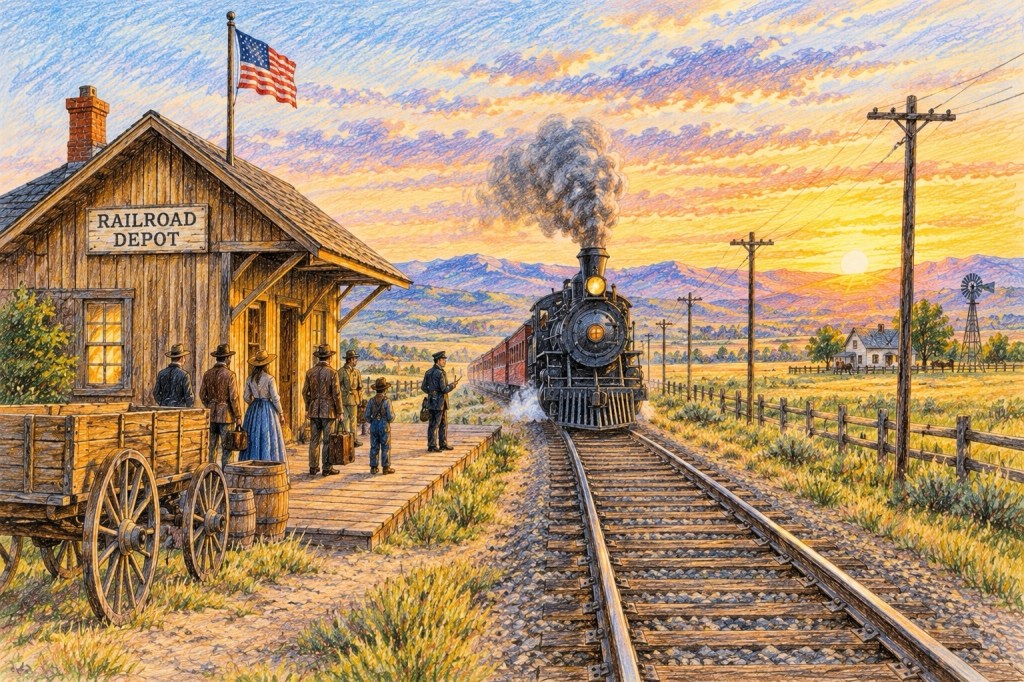
https://fineartamerica.com/featured/vintage-train-at-sunset-james-inlow.html?newartwork=true
For the first families who settled the American frontier, distance was more than a number on a map.
Distance meant time.
It meant how long it took to reach the nearest town.
How long it took to bring a wagonload of crops to market.
How long it took to receive news from family.
How long it took for supplies to arrive.
And sometimes, distance meant whether a community could survive at all.
Then came the railroad.
Steel rails began stretching across the landscape, connecting places that had once seemed impossibly far apart.
A farm that had been isolated suddenly had a station nearby.
A small settlement could become a town.
A town could become a city.
And the American West began changing at a remarkable speed.
The railroad was more than a transportation system.
It became one of the forces that reshaped the geography, economy, and daily life of the United States.
But like the homesteading story we explored yesterday, the story of the railroad is complicated.
It includes engineering, hard work, immigration, opportunity, economic growth, and remarkable technological achievement.
It also includes the displacement of Native peoples, environmental change, difficult working conditions, and conflicts over land and power.
To understand the American railroad is to understand another important chapter in the story of the American landscape.
Before the Rails
Before railroads crossed the West, transportation was slow.
People traveled by wagon, horseback, riverboat, and stagecoach.
Moving heavy goods across hundreds or thousands of miles could be enormously expensive and time-consuming.
A farmer might produce a successful harvest but still struggle to get it to a distant market.
A family might need manufactured goods that were difficult to obtain.
A letter could take weeks or months to travel.
The country was enormous.
The challenge was not simply settling the land.
It was connecting it.
By the middle of the nineteenth century, Americans increasingly imagined a railroad stretching across the continent.
Such a railroad would connect existing eastern rail networks with the Pacific Coast.
It would carry passengers.
It would carry mail.
It would carry farm products, livestock, manufactured goods, machinery, and raw materials.
And it would change the meaning of distance.
The Pacific Railway Act
The dream became a federal project during the Civil War.
On July 1, 1862, President Abraham Lincoln signed the Pacific Railway Act.
The legislation provided federal support for construction of a railroad and telegraph line connecting the Missouri River with the Pacific Ocean.
Two major companies were authorized to build the route.
The Union Pacific would build westward from the Omaha area.
The Central Pacific would build eastward from Sacramento, California.
The goal was enormous.
The continent itself stood between them.
Mountains.
Prairies.
Deserts.
Rivers.
Extreme weather.
And thousands of miles of difficult terrain.
The Homestead Act and the Pacific Railway Act were both passed in 1862, linking two major elements of western development: land settlement and transportation.
A person could claim land farther west.
The railroad could eventually make that land easier to reach.
Building Across a Continent
Building a railroad was not simply a matter of laying steel rails.
The ground had to be surveyed.
Grades had to be established.
Rock had to be blasted.
Hills had to be cut through.
Bridges had to be constructed.
Tunnels had to be dug.
Ties had to be positioned.
Rails had to be transported and installed.
Everything had to be done largely by hand.
The work was dangerous.
Workers faced heat, cold, snow, exhaustion, explosions, accidents, disease, and difficult terrain.
In the Sierra Nevada, the Central Pacific faced particularly difficult mountain construction.
In the Great Plains and farther west, the Union Pacific faced enormous distances and logistical challenges.
The railroad was literally being built one piece at a time.
The People Who Built the Railroad
The railroad could not have been built without thousands of workers.
Among the most important were Chinese immigrants who worked for the Central Pacific.
More than 10,000 Chinese laborers participated in construction at various points, performing difficult and dangerous work, including cutting through the Sierra Nevada.
Irish, German, Italian, and other immigrant workers also participated in railroad construction.
African Americans and other groups contributed to the construction and operation of railroads as well.
These workers came from very different backgrounds.
Some had come to America seeking opportunity.
Others were already living in the country.
Many endured extremely difficult working conditions.
The completed railroad became one of the great symbols of nineteenth-century American technological achievement, but the people who built it deserve to be remembered alongside the businessmen and engineers whose names became more famous.
Across the Great Plains
Imagine standing on the prairie in the 1860s.
The landscape seems almost endless.
Grass moves in the wind.
A few trees stand along a river.
A wagon road disappears toward the horizon.
Perhaps a homesteader’s cabin is visible several miles away.
Then, one day, surveyors arrive.
Markers are placed.
Workers begin grading the land.
Timber and construction materials appear.
And eventually, steel rails begin crossing the prairie.
The landscape is no longer the same.
A machine that would have seemed almost unbelievable a generation earlier is now moving across the horizon.
The railroad has arrived.
The Iron Horse
To people accustomed to horses and wagons, a steam locomotive must have seemed extraordinary.
It could pull enormous loads.
It could travel for long distances.
It did not need to stop every few miles to rest.
It connected places at a speed that changed people’s expectations.
A journey that had once required months could eventually take days.
The Library of Congress notes that completion of the first transcontinental railroad reduced a journey that could take four months or more to roughly one week.
That was not simply an improvement in transportation.
It changed how Americans thought about the country itself.
The continent suddenly felt smaller.
May 10, 1869
On May 10, 1869, something remarkable happened at Promontory Summit in Utah Territory.
The Central Pacific and Union Pacific tracks were joined.
A ceremonial golden spike was driven into the final connection.
The first transcontinental railroad had been completed.
A telegraph message announced the achievement across the country:
“DONE.”
For the people gathered at Promontory, it was a moment of celebration.
For the United States, it represented a new era.
The Atlantic and Pacific coasts were now connected by rail.
But the story was only beginning.
The Town Comes to the Railroad
One of the most visible effects of the railroad was the growth of towns.
Railroads needed places where locomotives could take on fuel and water.
Passengers needed stations.
Workers needed homes.
Farmers needed shipping points.
Businesses followed.
Hotels appeared.
Restaurants appeared.
Warehouses appeared.
General stores opened.
Banks arrived.
Blacksmiths and mechanics found customers.
A small settlement beside the tracks could grow rapidly.
Some towns prospered.
Others declined when railroad routes bypassed them.
In many places, the location of the railroad helped determine which communities would survive.
The railroad did not simply connect towns.
It helped decide where some towns would exist.
The Farm and the Railroad
For the homesteader we met in yesterday’s story, the railroad could change everything.
Imagine a farmer who once had to haul grain many miles by wagon.
The trip might take hours or even days.
The road could become muddy.
A wagon could break.
Animals could become exhausted.
The farmer might have limited access to distant markets.
Now imagine a railroad station a few miles away.
The farmer could bring crops to the station and ship them farther away.
Manufactured goods could travel in the opposite direction.
Farm equipment could arrive.
Lumber could arrive.
Clothing and household goods could arrive.
Mail could arrive.
The isolated homestead was becoming part of a national economy.
The Railroad and Immigration
Railroad companies also promoted western settlement.
Advertisements encouraged people to move west.
Maps showed new routes.
Land was marketed to prospective settlers.
The message was often simple:
There is land.
There is opportunity.
There is a future waiting for you.
For immigrants arriving in the United States, the railroad became part of the machinery that carried people toward new communities.
The result was an accelerating movement of people into western states and territories.
But the process was not simply spontaneous migration.
Railroad companies had economic interests.
They wanted passengers.
They wanted freight.
They wanted settlement along their lines.
They owned or received large amounts of land and had strong incentives to encourage people to buy or settle it.
The railroad therefore became both a transportation system and an engine of development.
The Railroad and Native Nations
There is another part of this story that cannot be left out.
The railroad crossed lands that had long been home to Native nations.
The rails did not enter an empty landscape.
They passed through established Indigenous homelands, hunting grounds, waterways, and places of cultural significance.
The National Park Service notes that the transcontinental railroad crossed the homelands of at least fifteen tribal nations.
Railroad construction and the settlement that followed affected access to land, water, wildlife, and traditional hunting areas.
The expansion of railroads also coincided with federal policies and military actions that profoundly disrupted Native communities.
One especially devastating change involved the destruction of the great bison herds.
Bison were essential to many Plains cultures.
Their rapid decline during the nineteenth century had enormous economic, cultural, and social consequences for Indigenous peoples.
The railroad therefore represents two very different experiences.
To many settlers and travelers, it meant connection and opportunity.
For Native communities, its arrival could mean another stage in the loss of access to lands and resources.
Both parts of that history belong in the story.
A New Sound in the Landscape
Before the railroad, the prairie had its own sounds.
Wind through the grass.
Birds.
Cattle.
Horses.
Wagons.
The occasional sound of a hammer.
Then came the locomotive.
The distant whistle.
The pounding wheels.
The hiss of steam.
The clank of couplings.
The vibration of the rails.
Imagine hearing that sound for the first time.
A train appears on the horizon.
It grows larger.
Smoke rises into the sky.
The locomotive passes.
And then, almost as quickly as it arrived, it disappears into the distance.
For someone living on an isolated homestead, that sound announced something important:
The outside world was coming closer.
The Railroad Changes Time
Railroads also changed the way Americans thought about time.
Trains had schedules.
Schedules required standardized timekeeping.
As railroads expanded, differences in local time became increasingly inconvenient.
Eventually, standardized time zones were adopted by the railroads in 1883.
The familiar system of time zones used in the United States grew out of this need for coordination.
Something as ordinary today as knowing what time it is in another city was partly shaped by the demands of the railroad age.
The railroad did not just change geography.
It changed time itself.
A Railroad Landscape
Look across an American landscape today and you may still find evidence of this transformation.
An old railroad bridge.
A water tower.
A depot.
A line of tracks disappearing toward the horizon.
A grain elevator.
A small town built along a rail line.
An abandoned right-of-way now used as a trail.
A weathered station preserved as a museum.
These places are easy to overlook.
But they are echoes of a time when the railroad represented the future.
Through the Artist’s Eye
This is the kind of landscape that fascinates me.
A railroad track seems simple.
Two lines of steel disappearing toward the horizon.
But look closer.
There is a story underneath it.
Someone surveyed the route.
Someone moved the earth.
Someone hammered spikes.
Someone operated the locomotive.
Someone waited at the station.
Someone sent a letter.
Someone boarded a train and left home.
Someone arrived in a town they had never seen before.
And somewhere nearby, a family watched the train pass from their farmhouse.
The railroad was never just steel.
It was movement.
It was connection.
It was change.
The West Was Never the Same
After 1869, additional railroad lines crossed the country.
The network expanded.
New towns developed.
Existing towns grew.
Agriculture became increasingly connected to distant markets.
Goods could travel farther.
People could travel faster.
The American economy became increasingly national.
The landscape itself changed as farms, ranches, mines, factories, towns, and cities expanded around the growing transportation network.
The age of the isolated frontier was beginning to give way to something different.
A connected America.
What the Railroad Left Behind
The railroad helped create enormous economic opportunities.
It also concentrated economic power.
Railroad companies became some of the largest corporations in the country.
Competition over routes, rates, land, and political influence generated disputes.
Railroad expansion brought investment and development, but not everyone benefited equally.
Workers faced dangerous conditions.
Farmers sometimes protested freight rates.
Communities could rise or decline depending upon railroad decisions.
And the enormous transformation of western lands came at great cost to Native nations and the natural environment.
The railroad was therefore neither simply a hero nor simply a villain.
It was a powerful force.
And powerful forces can create opportunity and disruption at the same time.
The Journey Continues
Yesterday, we imagined a homesteader standing outside a small cabin at sunrise.
Today, imagine that same person hearing a train whistle in the distance.
Perhaps the nearest station is still several miles away.
But it is there.
The world is moving closer.
A letter can arrive faster.
A crop can reach a distant market.
A child can travel to another town.
A family can receive goods from hundreds of miles away.
The future has arrived on steel rails.
And the landscape is changing with it.
The Echoes of the Iron Road
Today, we can travel across America without giving much thought to the distance.
We cross bridges without wondering how they were built.
We drive past railroad tracks without thinking about the people who laid them.
We see small towns without asking why they were built where they are.
But if we slow down, the landscape begins to speak.
A railroad track points toward a history of movement.
A depot tells us that people once gathered there.
A grain elevator tells us that agriculture depended upon transportation.
An abandoned rail line reminds us that communities and transportation systems can change.
And the old tracks disappearing toward the horizon still seem to ask a question:
Where does the road lead?
Perhaps that is why the railroad remains such a powerful symbol of America.
It represents movement.
Possibility.
Work.
Risk.
Connection.
And change.
The homesteader built a home.
The railroad connected that home to the country.
Together, they helped create a new American landscape.
But the story does not end with the railroad.
Because once the trains arrived, towns began to grow.
And where towns grew, something else appeared.
Main Street.
Tomorrow, we step into the small American town.
 Echoes of America
Leave a comment