Chronicles of the Republic: A Visual and Narrative History of America
Welcome to Chronicles of the Republic, an immersive journey through the heartbeats, trials, triumphs, and everyday lives of the people who shaped the United States. History is rarely just a sequence of dates; it is a tapestry woven from the sweat of laborers, the vision of revolutionaries, the grief of the oppressed, and the relentless pursuit of a more perfect union.
Step through the gallery of eras and experience the American story through words, historic artifacts, and immortal artwork.
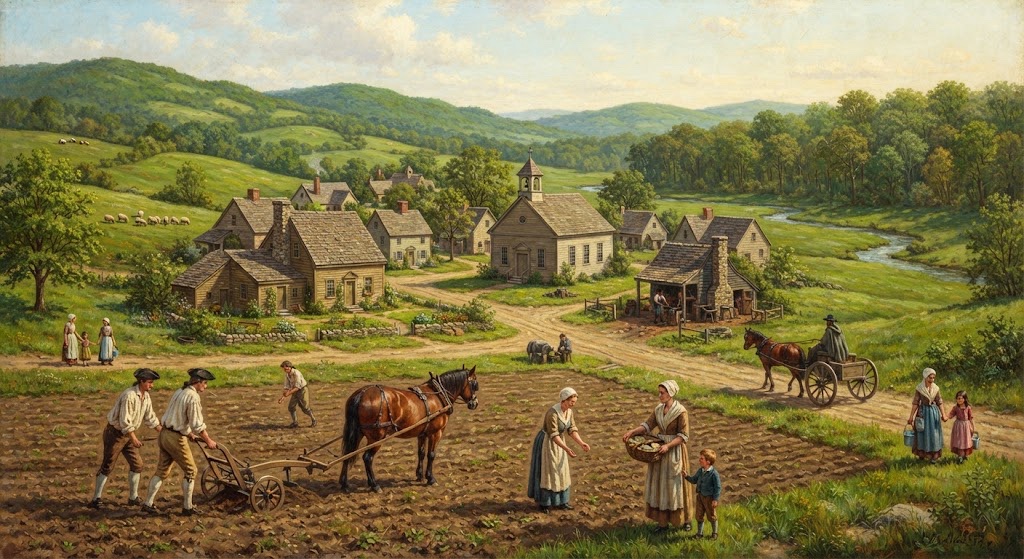
1. Roots, Contact, and Colonial Conflict (Beginnings–1763)
The Words
Long before the concept of “America” was inked onto European maps, a rich mosaic of indigenous civilizations thrived across the continent, cultivating complex trade networks, rich mythologies, and sustainable governance structures. The arrival of European powers in 17th and 18th centuries saw a patchwork of English, French, Spanish, and Dutch colonies claw their way into existence along the Atlantic seaboard—fueled violently by the trans-Atlantic slave trade and the forced labor of millions of enslaved Africans.
“We shall be as a city upon a hill. The eyes of all people are upon us.” — John Winthrop, 1630
Visual Gallery & Iconic Artwork
- Artifact/Image: Codex Mendoza (1542) — Illustrating Aztec life, tribute, and early Spanish contact dynamics.
- Painting: The Landing of the Pilgrims — capturing the windswept, prayerful arrival and early struggles on an unfamiliar shore.
- The Human Experience: Daily life was defined by backbreaking agrarian labor, the constant threat of borderland conflicts, and the silent resilience of enslaved communities forging clandestine kinship systems beneath the weight of chattel slavery.
2. Revolution and the Birth of a Nation (1763–1815)
The Words
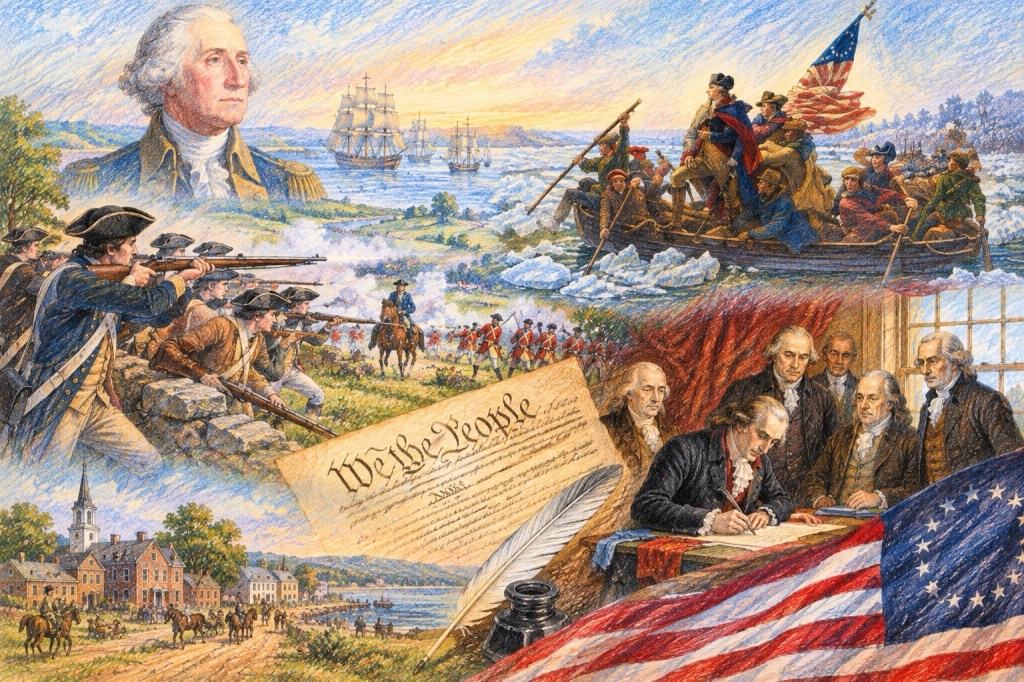
Friction between an overextended British Empire and its self-reliant American colonies erupted into ideological rebellion over the cry of “No taxation without representation.” The American Revolution forged a fragile republic out of blood, ink, and gunpowder. The ensuing U.S. Constitution and Bill of Rights established a radical framework for democratic self-governance—though glaringly hypocritical, as it protected the institution of slavery while championing universal liberty.
“We hold these truths to be self-evident, that all men are created equal…” — Thomas Jefferson, Declaration of Independence (1776)
Visual Gallery & Iconic Artwork
- Artifact/Image: The original masthead of the Massachusetts Spy reporting the battles of Lexington and Concord (1775).
- Painting: Washington Crossing the Delaware — An epic, heroic depiction of grit and surprise military strategy amid winter ice floes.
- The Human Experience: Farmers turned Continental militiamen shivering in encampments at Valley Forge, alongside free and enslaved Black patriots who fought for a country that did not yet fully recognize their humanity.
3. Expansion, Division, and the Crucible of Civil War (1815–1877)
The Words
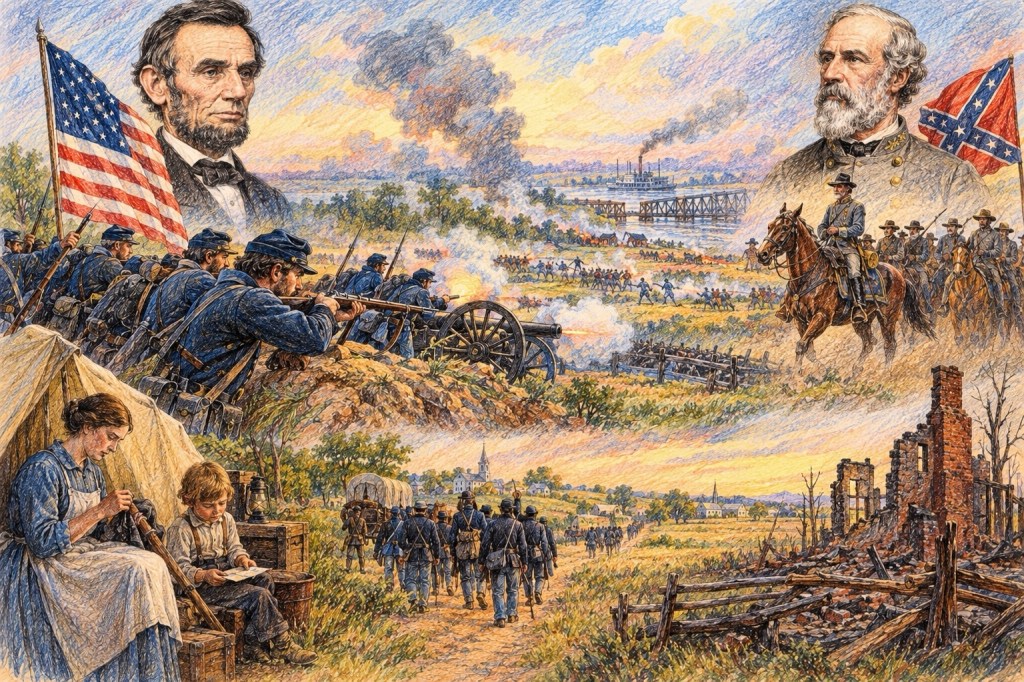
Fueled by the ideology of “Manifest Destiny,” the United States expanded aggressively westward—a journey that brought immense wealth and territorial size via the Louisiana Purchase, but brought catastrophic devastation to Native American nations through forced marches like the Trail of Tears. Simultaneously, the moral and economic chasm separating the industrializing North from the slave-labor plantation South widened into an irreconcilable chasm, culminating in the American Civil War (1861–1865)—a horrific conflict claiming over 600,000 lives to preserve the Union and eradicate chattel slavery.
“A house divided against itself cannot stand. I believe this government cannot endure, permanently half slave and half free.” — Abraham Lincoln, 1858
Visual Gallery & Iconic Artwork
- Artifact/Image: Matthew Brady’s haunting Civil War photography showing the skeletal devastation of Antietam and Gettysburg.
- Painting: American Progress style representation — Capturing the allegorical drive of settlers moving westward, transforming the landscape.
- The Human Experience: Emancipated families taking their first uncertain, courageous steps toward self-determination during the Reconstruction era, only to face the rising backlash of Jim Crow segregation.
4. Industrial Might, Reform, and Global Conflict (1877–1945)
The Words
The turn of the 20th century transformed America from a rural society into an industrial superpower. Towering skyscrapers pierced city skylines, powered by millions of European immigrants and internal migrations. Yet, this Gilded Age wealth hid deep societal rot, prompting the Progressive Era’s crusade against corporate monopolies and political corruption. Soon, isolationism crumbled as the nation was thrust onto the global stage through World War I, the devastation of the Great Depression, and ultimately the planetary cataclysm of World War II.
“The only thing we have to fear is fear itself.” — Franklin D. Roosevelt, First Inaugural Address (1933)
Visual Gallery & Iconic Artwork
- Artifact/Image: Lewis Hine’s gripping documentary photographs of child laborers trapped inside hazardous textile mills.
- Painting: Nighthawks style representation — Capturing the quiet alienation, urban isolation, and psychological strain of mid-century American life.
- The Human Experience: Immigrant families processing through Ellis Island beneath the copper gaze of the Statue of Liberty; “Rosie the Riveter” welding bomber planes; and Dust Bowl farmers abandoning parched homesteads for California’s promised valleys.
5. Civil Rights, Cold War, and the Modern Era (1945–Present)
The Words
Emerging from World War II as an atomic titan, the United States locked into a tense, decades-long ideological chess match with the Soviet Union known as the Cold War. Domestically, the nation wrestled with its internal conscience. The Civil Rights Movement—led by towering moral voices demanding racial equality—shattered legal segregation. This era sparked a cascading wave of liberation movements, including women’s liberation, environmentalism, and LGBTQ+ advocacy, all driving toward a more inclusive democracy against the backdrop of the digital and information revolutions.
“I have a dream that one day this nation will rise up and live out the true meaning of its creed…” — Martin Luther King Jr., 1963
Visual Gallery & Iconic Artwork
- Artifact/Image: A live television broadcast screen showing Neil Armstrong taking humanity’s first steps on the Moon (1969).
- Painting / Visual Art: Pop-art and movement representations reflecting the turbulent yet hopeful pulse of modern social change.
- The Human Experience: Activists linking arms across historic bridges; citizens protesting foreign wars; and modern digital communities navigating an interconnected yet deeply polarized global landscape.
Reflecting on the Journey
The history of the United States is not a polished monument; it is a living, breathing work-in-progress. It is found in the clash of ideals and the stubborn hope of ordinary people striving to make the promise of liberty a reality for all.
 Echoes of America
Leave a comment