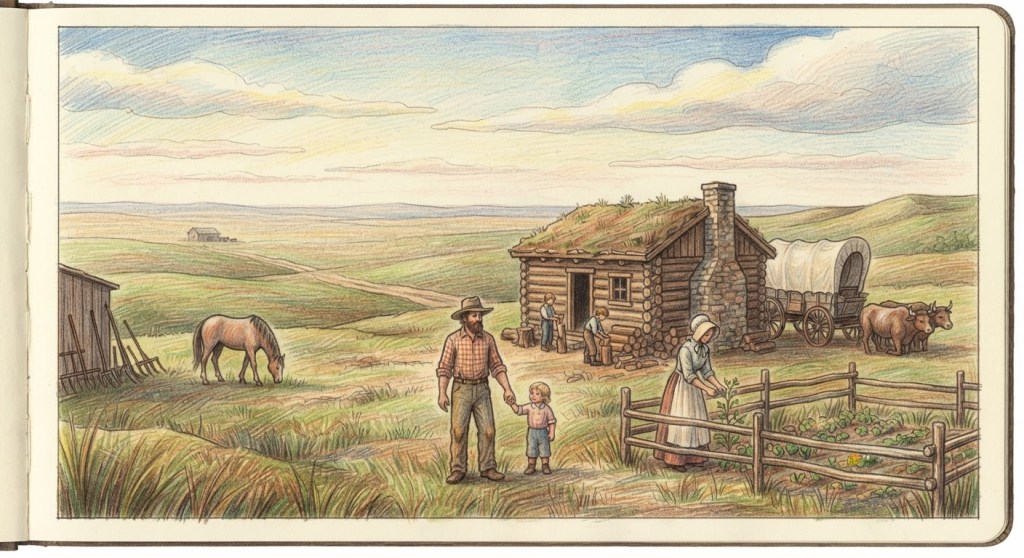
https://fineartamerica.com/featured/life-on-the-prairie-homestead-james-inlow.html?newartwork=true
A farmhouse surrounded by fields can look as though it has always been there.
The barn seems rooted to the earth.
The fence follows the contours of the land.
Trees shade the house.
A country road disappears toward the horizon.
And when the morning sun rises over the fields, it is easy to imagine that the farm has always belonged to the family living there.
But every farm has a beginning.
Someone built the house.
Someone planted the first crop.
Someone dug the first well, built the first fence, and endured the first winter.
For thousands of Americans, the dream of creating such a place was connected to one of the most important land laws in American history:
The Homestead Act of 1862.
But the story of the American homestead is not only a story of opportunity. It is also a story of migration, labor, community, displacement, perseverance, and change.
Today, we’ll follow that story from the promise of land to the difficult work of making a home—and then to the farms and rural communities that still carry those echoes.
A Promise of Land
On May 20, 1862, President Abraham Lincoln signed the Homestead Act into law. The law took effect on January 1, 1863.
It allowed eligible applicants to claim up to 160 acres of surveyed federal land, generally in areas designated for homesteading.
But the land was not simply handed over.
An applicant usually had to file a claim, establish residence, make required improvements, and cultivate the property. After five years of continuous residence and compliance with the law, the homesteader could apply for a patent establishing ownership. Other options, including a shorter residence period combined with payment for the land, were also available under the law.
The Homestead Act encouraged settlement and agricultural development across a vast portion of the country. It was part of a larger federal land policy that included later homestead laws and related programs.
By 1900, homesteaders had filed roughly 600,000 claims covering about 80 million acres. Eventually, more than 270 million acres—approximately 10 percent of the area of the United States—were transferred through the Homestead Act and related homesteading provisions.
Those figures refer to land entries and patents under a broad group of federal homestead laws. They do not mean that every applicant received a successful farm. Many claims were abandoned, canceled, or never completed.
The numbers are enormous.
But behind every claim was a person.
And behind every person was a story.
Who Became a Homesteader?
The image we sometimes have of a homesteader is a man standing beside a log cabin.
The actual history was much broader.
Immigrants came seeking opportunity.
Farmers who did not own land traveled west.
Single women who met the legal requirements could file claims in their own names.
African Americans also participated in homesteading, especially after the Civil War, although they faced discrimination, limited access to credit, violence, and other barriers that made land acquisition and retention difficult.
The National Park Service describes nearly four million homesteaders settling land across 30 states during the 123 years in which federal homesteading programs operated. That is a broad estimate for the homesteading era and related laws, not a count of people who all received land under the original 1862 act alone.
For some, homesteading represented independence.
For others, it offered a chance to establish a farm that could support a family.
For immigrants, land ownership could become part of a new life in a new country.
But the promise of land did not mean an easy life.
Far from it.
The Journey to the Claim
Imagine receiving word that land is available hundreds of miles away.
You decide to go.
You sell or leave behind what you cannot take. You gather clothing, tools, food, seed, household goods, and whatever equipment you can afford.
Perhaps you have a wagon.
Perhaps you have livestock.
Perhaps you have children.
And then you begin traveling.
Not every homesteader crossed an untouched prairie by wagon. Some arrived by railroad, riverboat, or established road. Many moved only a few counties or states away.
But for those traveling long distances, the journey could be physically demanding and expensive.
Roads were rough.
Weather was unpredictable.
Rivers could become dangerous.
Equipment could break.
Animals could become sick.
And every mile carried you farther from the life you already knew.
Eventually, the familiar world disappeared behind you.
Ahead was the land where you hoped to build your future.
The First Night
When you arrive at your claim, there is no finished farmhouse waiting for you.
No paved driveway.
No electricity.
No grocery store down the road.
No established neighborhood.
Perhaps there is not even a mature tree nearby.
There is only the land.
For some families, the first shelter might be a dugout, sod house, small cabin, or other temporary structure. The choice depended on local materials, climate, finances, labor, and the character of the land.
The first priority was survival.
Find water.
Create shelter.
Protect the animals.
Prepare food.
Then begin the work of turning a piece of land into a home.
The dream of owning land could quickly become a lesson in how difficult landownership actually was.
Five Years to Prove It
The Homestead Act required more than simply occupying the land.
A homesteader had to establish residence and make the improvements required by law. Cultivation was part of the process, but the exact requirements varied according to the law in effect and the type of claim.
That meant building.
Planting.
Fencing.
Improving.
Working.
And continuing even when the results were disappointing.
The goal was eventually to “prove up” the claim and receive the legal patent to the property.
Five years may not sound especially long today.
But imagine spending those years in a small cabin or sod house while trying to establish a farm.
Imagine the winters.
Imagine the droughts.
Imagine storms sweeping across the plains.
Imagine watching a crop fail after months of work.
And then imagine waking up the next morning and beginning again.
That was the reality for many homesteaders.
Not everyone succeeded. Some abandoned their claims because of drought, debt, illness, isolation, poor soil, severe weather, or the difficulty of meeting legal requirements.
The land promised opportunity, but it demanded endurance.
The Land Was Not Empty
There is another essential part of this story.
When government documents and advertisements described western land as available for settlement, they were often describing land that Native nations already inhabited and regarded as home.
The West was not an empty landscape waiting for Americans to arrive.
Indigenous peoples had lived there for generations, maintaining communities, cultures, economies, and relationships with the land.
Federal policies, treaties, military actions, removals, reservations, and later allotment policies transformed Native control of the land.
The Homestead Act became part of that much larger process.
Its operation was connected to the federal government’s acquisition and opening of lands that had been Native homelands or treaty-protected territories. In some cases, land was opened to homesteading after treaties were violated, reservations were reduced, Native nations were forcibly removed, or reservation lands were allotted and surplus lands were made available to non-Native settlement.
The Dawes Act of 1887, for example, divided many reservation lands into individual allotments and authorized the sale or opening of “surplus” lands. This policy caused enormous losses of Native land and sovereignty. It was not the same law as the Homestead Act, but both operated within the broader expansion of federal control and non-Native settlement.
Understanding this history does not take away from the determination of individual homesteaders.
It gives us a fuller picture.
A family could be working incredibly hard to establish a home while, at the same time, the expansion of the United States was changing the lives, political authority, and lands of Indigenous peoples.
Both stories belong to American history.
From Isolated Claim to Community
Once the first shelter was established, the transformation continued.
A field was cultivated.
A fence was built.
A well was dug.
A barn or stable appeared.
Perhaps a chicken coop was added.
A garden provided vegetables.
Crops were planted.
Animals were raised.
A windmill might eventually appear against the horizon.
Little by little, the landscape changed.
One homestead became another.
Then another.
Soon there were roads, schools, churches, post offices, stores, and towns.
Railroad connections brought new movement and new markets.
What began as isolated claims could become an agricultural community.
But these communities were not created by homesteaders alone. Native communities, Mexican American communities, African American communities, immigrant settlements, merchants, railroad workers, teachers, clergy, and laborers all shaped the social history of the West.
Imagine the countryside after several years.
A neighbor’s wagon passes on the road.
Children walk toward a small schoolhouse.
Someone repairs a fence.
A blacksmith’s hammer rings in the distance.
A church bell can be heard on Sunday morning.
A train whistles somewhere beyond the fields.
The silence is different now.
The first generation of settlers has created something that was not there before.
Not simply farms.
A community.
And that community becomes part of the next generation’s idea of home.
Women on the Homestead
The history of homesteading also includes thousands of women whose stories can be overlooked.
The Homestead Act did not require an applicant to be male. Single women who met the legal requirements could file claims in their own names.
Married women’s legal and economic options varied by state, local custom, and household circumstances. Many women contributed substantially to claims filed by husbands or other relatives without receiving formal title.
Women worked claims, built homes, planted crops, managed households, raised children, cared for animals, preserved food, and helped establish communities.
For some single women, land ownership represented an unusual degree of economic independence for the nineteenth century.
But filing a claim did not guarantee independence or success.
Women faced the same environmental hardships as men, along with gender restrictions, limited access to credit and equipment, unequal wages, and social expectations that shaped what they could do.
Historians have studied connections between women homesteaders, property ownership, civic participation, and the development of ideas surrounding women’s rights and suffrage.
Those connections were real but not uniform.
Homesteading did not automatically produce political equality. Women’s experiences differed by race, class, marital status, region, and access to resources.
A homestead was therefore not simply a story about men moving west.
It could also be a story about women making decisions about their own futures.
The African American Homesteader
The homesteading story also includes African Americans.
After the Civil War, African Americans could legally participate in federal homesteading, particularly as federal citizenship rights expanded.
But the Homestead Act did not create equal access to land.
Black homesteaders faced discrimination in land offices, lending, employment, transportation, education, and local politics. In many areas, racial violence and intimidation threatened both settlement and property ownership.
Black homesteaders established farms and communities in several western states, including parts of Kansas, Oklahoma, Nebraska, Colorado, and the Dakotas.
Some communities became important centers of Black agricultural, religious, and civic life.
Their experiences, however, took place within a broader society where discrimination and unequal access to economic resources created significant obstacles.
Land could be lost through debt, tax problems, fraudulent practices, legal pressure, violence, or forced sale.
Some communities succeeded.
Others struggled or disappeared.
Their stories remind us that the history of the American West was not simply a story of one population moving across the continent.
It involved many communities seeking land, opportunity, security, and independence.
When the Farm Begins to Look Familiar
Years pass.
The little cabin may eventually be replaced.
A larger farmhouse rises beside the road.
The barn becomes more substantial.
Trees planted around the house grow tall.
Children grow up.
A new generation is born.
The farm begins to look like the American countryside we recognize today.
A farmhouse.
A barn.
A silo.
A windmill.
Fields stretching toward the horizon.
A gravel or dirt road.
A fence following the edge of a pasture.
Perhaps a pond reflecting the morning sky.
What once represented uncertainty now looks permanent.
But permanence is an illusion.
Every generation changes the farm.
Electricity, Machinery, and a New Rural Life
The twentieth century brought enormous changes to rural America.
The horse gave way to the tractor.
Mechanical equipment changed planting and harvesting.
Better roads connected farms to markets.
Telephones brought communication to rural communities.
Eventually, electricity transformed daily life.
In the early twentieth century, most rural farms lacked access to commercial electric service, even though electricity was becoming common in many cities and towns.
In 1935, the federal government created the Rural Electrification Administration, or REA, through the Emergency Relief Appropriation Act. The REA initially provided loans to electric cooperatives and other organizations to extend power lines into rural areas.
The Rural Electrification Act of 1936 strengthened and continued that program.
The REA did not instantly electrify the countryside. Local cooperatives had to organize, secure financing, build lines, and connect customers.
Electrification expanded gradually, especially from the late 1930s through the postwar decades.
Imagine what that change meant.
A farmhouse that had relied on kerosene lamps could now have electric lights.
A farmer could use electric equipment.
A radio could bring news and music into the kitchen.
Refrigeration changed food storage.
Pumps and other equipment made certain tasks easier.
Electricity also changed expectations. It affected household labor, education, communication, health, farm production, and the relationship between rural communities and the wider nation.
The modern farm was emerging.
What Was Gained—and What Was Lost?
Progress changed rural America.
Some work became faster.
Some tasks became safer or less physically demanding.
Farm productivity increased.
Electricity improved lighting, refrigeration, water systems, communication, and household life.
But change also had consequences.
As agriculture became increasingly mechanized and larger-scale operations became more common, many small farms struggled to remain economically viable.
Mechanization was only one factor. Debt, commodity prices, land values, federal policy, transportation, changing markets, and access to credit also shaped the fate of family farms.
Rural populations shifted.
Some small towns declined.
Country stores disappeared.
Family farms were sold or combined with larger operations.
The landscape itself changed.
The old farmhouse might remain, but the people living in it could change.
The barn might still stand, but the animals might be gone.
A country road might still wind through the fields, but the family that once traveled it every day may have moved away.
The landscape can survive even when the way of life that created it changes.
Through the Artist’s Eye
This is where I find something especially powerful about the American farm.
A farm can be beautiful.
But its beauty is not the whole story.
When I look at a farmhouse beneath a sunrise, I see more than a building.
I see the people who may have built it.
I see the hands that planted the fields.
I see the children who grew up there.
I see the seasons passing.
I see the struggles that are not visible in the finished landscape.
And I see the hope.
That is what I want to capture in the artwork associated with this story.
Not simply a pretty farm.
But a feeling.
The feeling of standing at the edge of a field early in the morning.
The cool air.
The smell of soil and grass.
The distant sound of livestock.
The first light touching the barn.
The long road leading somewhere beyond the horizon.
A painting can preserve that moment.
It can turn a landscape into a memory.
What Makes a Place Home?
Perhaps the most important question in the story of the American homestead is a simple one:
What makes a place home?
Is it the house?
The land?
The people?
The memories?
The work invested in it?
Maybe it is all of these things.
A piece of land begins as property on a map.
But after years of work, it becomes something more.
Someone plants a tree.
Someone builds a porch.
Someone marks a child’s height on a doorframe.
Someone gets married there.
Someone grows old there.
Someone leaves.
Someone returns.
And eventually, the land becomes filled with memories.
That is when property becomes home.
The Echoes That Remain
Today, millions of Americans live in places that began as farms or homesteads.
Some historic farmhouses remain.
Some barns have been restored.
Some old homestead sites have disappeared beneath towns and cities.
Others remain surrounded by fields.
In some places, original wagon roads have become modern highways.
The small family garden became a commercial farm.
The horse became a tractor.
The kerosene lamp became an electric light.
But the fundamental desire to create a place to call home remains.
That may be the strongest echo left by the homestead era.
The Morning After
Imagine returning to the farm at sunrise.
The farmhouse is quiet.
The fields are covered in morning light.
The barn stands where it has stood for generations.
A fence runs toward the horizon.
Perhaps a tractor waits beside the barn.
Perhaps cattle graze in the pasture.
The windmill turns slowly.
The road disappears into the distance.
It looks peaceful.
But now you know more of the story.
You know that farms do not simply appear.
They are built.
They are worked.
They are inherited.
They are sold.
They are changed.
They are sometimes lost.
And sometimes, they survive for generations.
Every farmhouse has a beginning.
Every field has a history.
Every road has carried people whose stories may never appear in a textbook.
And every sunrise gives us another opportunity to remember them.
The Journey Continues
The American homestead was part of a much larger transformation of the United States.
It changed the landscape.
It encouraged migration.
It helped establish farms and communities.
It opened opportunities for some people while contributing to profound changes and losses for others.
Its legacy can still be seen across the American countryside.
Look at an old farmhouse.
Look at a barn.
Look at a field divided by a fence.
Look at a country road disappearing toward the horizon.
You may be looking at more than scenery.
You may be looking at an echo of a decision someone made generations ago:
“This is where we will build our home.”
And perhaps that is why the image of the American homestead still feels so powerful.
It reminds us that home is not always something we inherit fully formed.
Sometimes, it is something people build slowly, through uncertainty and effort, one day at a time.
The story of the homestead is also a reminder that every landscape contains more than one history.
The fields may hold the memory of settlers who worked to establish farms.
They may also hold the memory of Native nations whose homelands were transformed, African American families who fought to secure land and community, immigrant families who began again, and rural residents who adapted as the countryside changed around them.
To look closely is to see all of those stories at once.
This is Echoes of America.
Where history lives in the landscapes around us.
Where a farmhouse can become a doorway into the past.
And where every sunrise gives us another story to remember.
Until tomorrow, keep looking, keep listening, and keep discovering the echoes of America.
 Echoes of America
Leave a comment