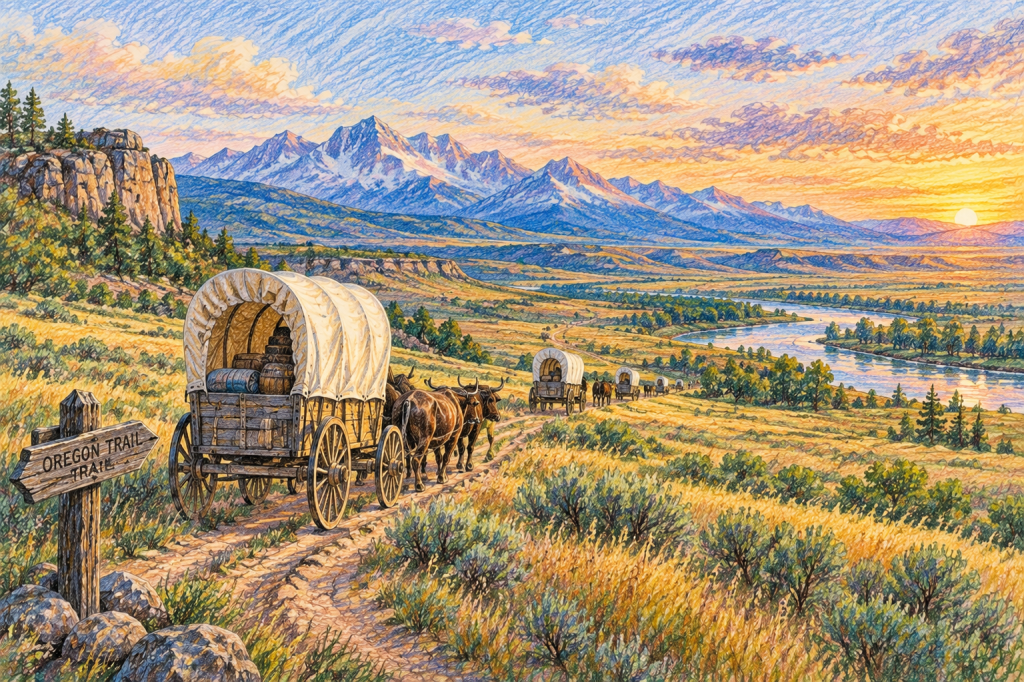
Day 3 — The Trail to Oregon
https://fineartamerica.com/featured/sunset-journey-with-covered-wagon-james-inlow.html
There is something about an old trail that makes us wonder who walked it before us.
Today, we can cross much of the country in a matter of hours. In the nineteenth century, traveling from the Missouri River to Oregon could take months.
For thousands of emigrants, the journey west meant leaving behind familiar homes and heading toward a future they could only imagine.
The route that became known as the Oregon Trail stretched roughly 2,000 miles from the Missouri River across the Great Plains, through what are now Nebraska, Wyoming,Crete a colored pencil Idaho, and Oregon. Between 1840 and 1870, roughly 500,000 people traveled along the Oregon Trail and related routes toward destinations in the American West. (National Park Service)
But the trail was more than a line on a map.
It was a journey filled with hope, uncertainty, exhaustion, loss, and discovery.
The Journey Begins
In the early 1840s, families and individuals gathered at towns along the Missouri River before beginning the long journey west.
In 1841, one of the first emigrant wagon parties left Independence, Missouri, with about 80 men, women, and children under the guidance of Thomas Fitzpatrick. Two years later, a much larger migration followed. In the spring of 1843, nearly 1,000 people organized at Independence and traveled toward Oregon Country. (National Park Service)
Imagine what it must have been like to stand there.
Wagons loaded with food, clothing, tools, household possessions, and whatever else a family believed it would need.
Animals ready for the journey.
Children who had never seen the country they were traveling toward.
Parents wondering what awaited them.
Behind them was everything they knew.
Ahead was thousands of miles of country they had never seen.
A Road Through a Continent
The Oregon Trail was not one perfectly defined road.
It developed from earlier routes, including trails used by Indigenous peoples, fur traders, explorers, missionaries, and others. As more emigrants traveled west, routes changed, shortcuts developed, and different branches appeared.
The journey crossed enormous landscapes.
Prairie.
River valleys.
Desert.
Mountain passes.
Forests.
The travelers had to deal with weather, disease, accidents, difficult terrain, and the constant challenge of finding enough food and water.
During the 1840s, an average journey could take about 169 days, with wagon parties commonly covering only 12 to 15 miles in a day. By the 1850s, improvements in routes and accumulated knowledge helped reduce the average journey to roughly 128 days. (National Park Service)
A trip that today might seem almost unimaginable was, for many families, simply the road they had chosen to take.
Crossing the Rockies
One of the great challenges came when the travelers reached the Rocky Mountains.
South Pass, in present-day Wyoming, became one of the most important points on the journey. The broad valley provided a relatively gentle crossing of the Continental Divide and became crucial to wagon travel along the Oregon Trail. (National Park Service)
For someone traveling with a wagon, oxen, children, and months of supplies, reaching South Pass must have been an extraordinary moment.
Beyond it lay another part of the journey.
But reaching the pass also meant that the travelers had crossed one of the great natural barriers of the continent.
The landscape itself told them how far they had come.
The People of the Land
There is another part of this story that should never be forgotten.
The Oregon Trail did not cross an empty wilderness.
Indigenous nations had lived throughout these regions for generations. Their communities, trading networks, trails, hunting grounds, and relationships with the land long predated American westward migration.
As increasing numbers of emigrants traveled west, the effects on Indigenous communities grew.
Settlers competed for land and resources. Game populations and access to water and timber were affected. The United States increasingly asserted control over lands inhabited by Native nations, and many Indigenous people were eventually forced from their homelands through treaties, coercion, and government action. (National Park Service)
The history of the Oregon Trail therefore cannot be told only as an adventure of pioneers seeking a new home.
It is also part of the much larger history of Indigenous dispossession and the transformation of the American West.
Remembering both sides of that history gives us a fuller picture of what the trail meant.
What Did They Find?
After months on the trail, reaching Oregon was not the end of the story.
It was the beginning of another one.
New arrivals had to find somewhere to live, obtain food, earn money, find land, and build communities.
Some arrived with expectations shaped by glowing descriptions of Oregon’s fertile valleys and opportunities. Reality could be considerably more difficult.
Some families spent their first winter living temporarily with friends, relatives, or strangers while they searched for land and established permanent homes. Others struggled to find work or adapt to their new surroundings. (National Park Service)
The dream of a new life did not guarantee an easy life.
But communities grew.
Roads improved.
Businesses appeared.
Towns expanded.
And the landscape of the Pacific Northwest began to change dramatically.
The Echoes Along the Trail
Today, much of the Oregon Trail is hidden beneath modern roads, farms, towns, and cities.
But traces remain.
Ruts carved into the earth by wagon wheels.
Old landmarks beside rivers.
Historic sites.
Mountain passes.
Graves.
And landscapes that look remarkably similar to those seen by travelers generations ago.
Standing beside one of these places, it is possible to imagine the sound of wagon wheels and the creaking of wooden axles.
Perhaps a family stopped here for the night.
Perhaps someone stood on a hill and looked toward the mountains.
Perhaps a child who had spent months traveling finally asked the question:
“Are we there yet?”
Through the Artist’s Eye
This is where history and art meet.
A landscape doesn’t have to contain a monument to be historic.
Sometimes an old road is enough.
A mountain range.
A river.
A weathered tree.
A wagon trail disappearing toward the horizon.
When I look at a scene like this, I don’t just see the landscape.
I imagine the people who passed through it.
I imagine their hopes.
Their fears.
Their exhaustion.
Their determination.
And I think about how different America looked to them—and how much of that landscape still surrounds us today.
That is the kind of story I want to capture through my artwork.
Not simply what a place looks like.
But what it might have meant to the people who stood there.
The Trail Lives On
The Oregon Trail is no longer the primary road to a new life in the West.
But its story remains part of the American landscape.
It reminds us that America was shaped by movement—by people crossing rivers and mountains, building communities, seeking opportunity, and sometimes being displaced by the expansion of others.
It reminds us that beautiful places can hold complicated histories.
And it reminds us that every road has a story.
The next time you see an old trail disappearing into the distance, stop for a moment.
Look toward the horizon.
Imagine the people who once stood where you are standing.
Then listen.
Perhaps you can still hear an echo.
The journey west continues tomorrow.
 Echoes of America
Leave a comment