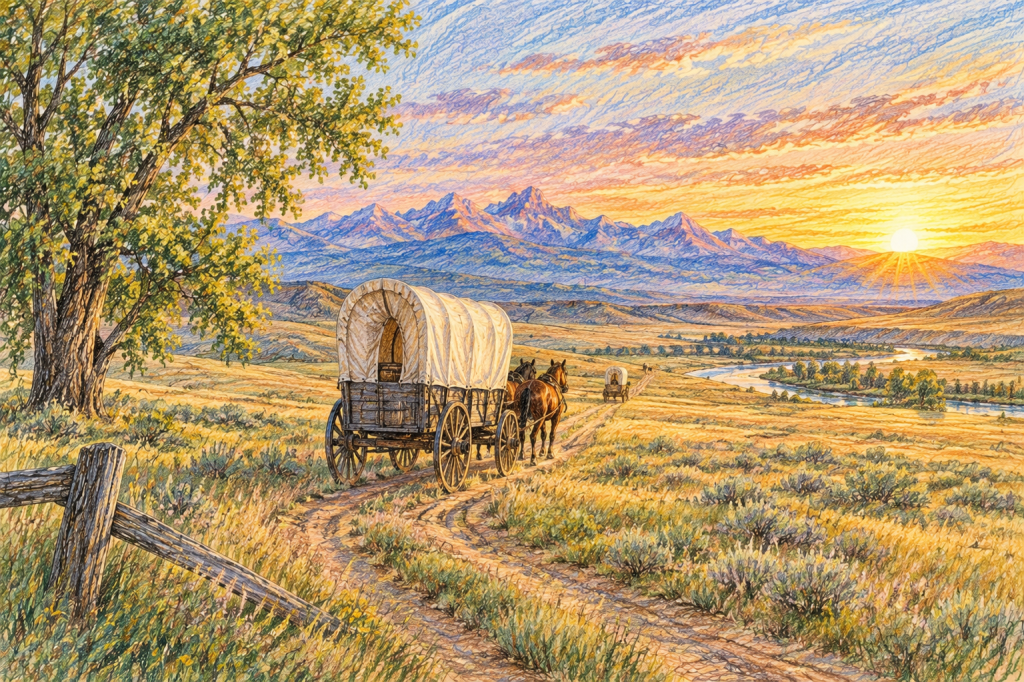
https://fineartamerica.com/featured/sunset-journey-with-covered-wagon-james-inlow.html
The Road West
There was a time when a road could mean everything..
It could mean leaving behind a familiar home and heading toward a place you had never seen. It could mean opportunity, uncertainty, hardship, or simply the hope that somewhere beyond the horizon there might be a better life.
For thousands of Americans, the road west became one of the defining journeys of the nineteenth century.
But the story of westward expansion is more complicated than the familiar image of a wagon rolling across an open prairie. The land was already home to countless Native peoples and communities, each with their own histories, cultures, and connections to the places they lived.
The westward movement brought new settlements, farms, towns, roads, and railroads. It also brought conflict, broken treaties, forced removals, loss of land, and enormous changes to Native communities.
To understand the American frontier, we have to remember all of these stories.
Beyond the Horizon
Imagine standing on a rise overlooking a vast prairie.
There is no highway in sight.
No telephone poles.
No buildings stretching toward the horizon.
Perhaps there is only a rough wagon road disappearing into the distance.
The grass moves with the wind, and somewhere far away a line of trees follows a river.
For a traveler heading west, the landscape could seem almost endless.
Families traveled by wagon carrying the belongings they could take with them. Farmers searched for land. Merchants and adventurers followed established trails. Others were drawn west by the discovery of gold and other opportunities.
The journey itself could be difficult.
There were rivers to cross, mountains to climb, storms to endure, and long stretches where food, water, and medical help were scarce.
For many travelers, the dream of a new beginning came with a very real price.
The People Already There
It is important not to imagine the West as an empty wilderness waiting to be discovered.
It wasn’t.
Long before American settlers traveled west, Native nations had lived throughout these regions for generations—cultivating crops, hunting, trading, governing communities, and maintaining deep relationships with the land.
As the United States expanded, Native peoples faced increasing pressure as settlers, military forces, miners, farmers, and railroads moved into their territories.
Treaties were made and frequently violated. Native communities were removed from their homelands, sometimes by force. Wars and violence followed, along with devastating losses of lives, land, resources, and cultural traditions.
The frontier story is therefore not simply a story of adventure.
It is also a story of people whose lives were profoundly changed by the expansion of the United States.
Remembering that history doesn’t diminish the beauty of the American landscape.
It gives the landscape more meaning.
The Road That Became a Town
Eventually, many of the trails that carried travelers west became something else.
A crossroads became a settlement.
A settlement became a town.
A trading post became a commercial center.
A railroad station brought new people and businesses.
Wooden buildings appeared along a dusty main street. A general store opened its doors. A blacksmith went to work. A church bell began to mark the hours.
And slowly, a community took shape.
Some towns survived and grew.
Others disappeared almost as quickly as they appeared.
Today, we may drive through these places without realizing what once stood there.
An old foundation beside a road might be all that remains.
An abandoned cemetery may contain the names of families who arrived generations ago.
A weathered barn may be one of the last reminders of a farm that once stretched across hundreds of acres.
These quiet places are part of the echoes of America.
Through the Artist’s Eye
This is one of the reasons I find the American landscape so compelling.
A landscape can be beautiful and still contain history.
A peaceful field may have once been part of a trail.
A river may have carried travelers and supplies.
A mountain pass may have been crossed by thousands of people.
A quiet town may have once been a bustling frontier community.
When I create artwork inspired by these places, I want to capture more than scenery.
I want to capture a feeling of time.
The worn fence.
The old road.
The distant mountains.
The farmhouse standing beneath the morning sky.
The feeling that someone passed this way long ago—and left a story behind.
What the Road Left Behind
Westward expansion changed the United States in ways that can still be seen today.
It changed where people lived.
It changed agriculture and commerce.
It connected distant communities through roads and railroads.
It created new states and towns.
It also left behind difficult histories that continue to be remembered and studied.
The American West was never simply one thing.
It was a place of dreams and disappointments, courage and conflict, opportunity and loss.
Perhaps that is true of America itself.
Our history becomes more meaningful when we are willing to look at the whole picture.
Not only the beautiful parts.
Not only the difficult parts.
But the stories that connect them.
The Road Continues
Today, many of the old trails have disappeared beneath modern roads.
But if you know where to look, traces of the past are still there.
A wagon road.
An old bridge.
A weathered farmhouse.
A forgotten cemetery.
A town with a century-old main street.
A mountain pass.
A riverbank.
Each one offers another opportunity to stop and listen.
Because sometimes the best way to understand America’s history is not to stand in front of a monument.
Sometimes it’s to stand beside an old road and wonder:
Who traveled this way before us?
What were they looking for?
What did they leave behind?
And what stories are still waiting to be remembered?
The road west is still there in pieces.
And tomorrow, we’ll follow another echo of America
Tomorrow “THE OREGON TRAIL”
 Echoes of America
Leave a comment