
Postcard from America · No. 1
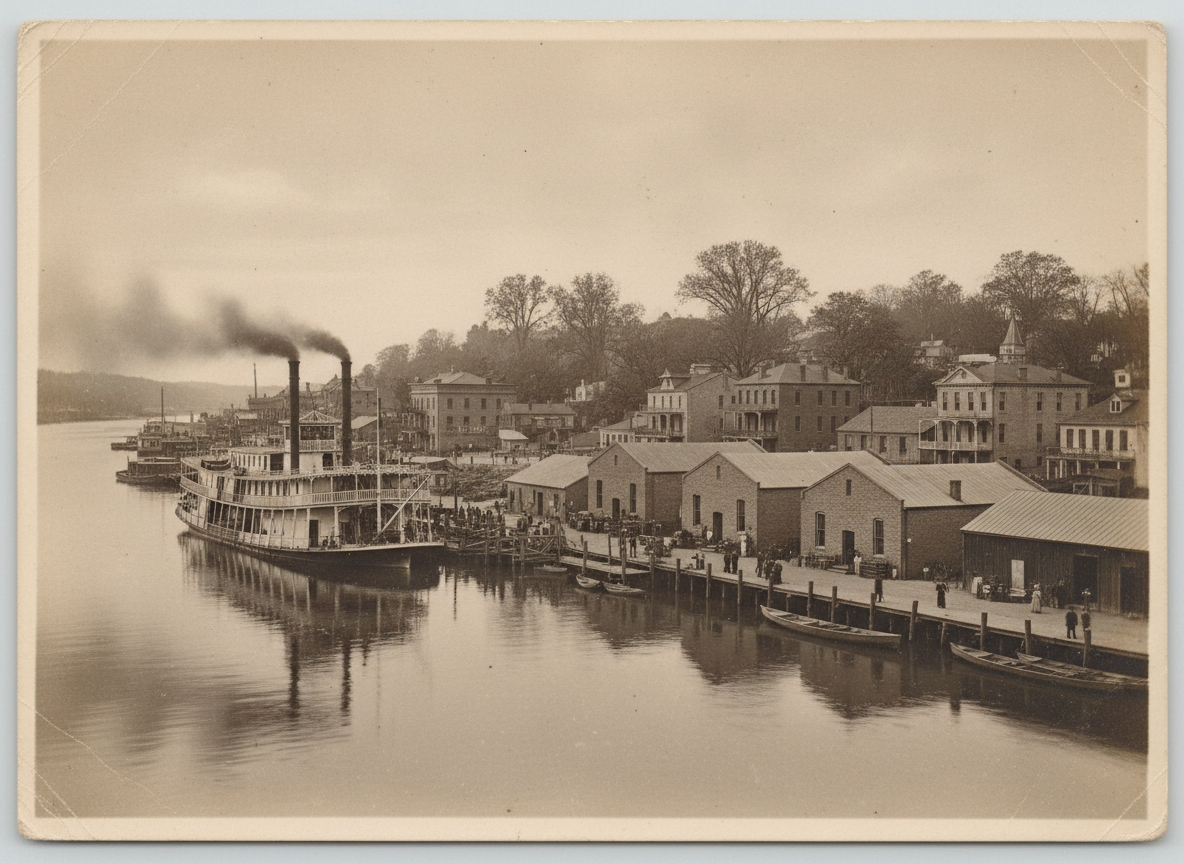
A River Town on the Mississippi
Before highways connected the country and before the age of modern travel, rivers were among America’s great roads. Along their banks grew towns where people worked, traded, raised families, and watched the nation change.
The Mississippi River was more than a line on a map. It was a moving highway, a source of food and work, a boundary, and a meeting place. Steamboats carried passengers and freight. Farmers brought crops to market. Merchants built stores near the water. Travelers arrived with stories from places many local residents would never see.
Where the River Met the Town
In a river town, daily life was closely connected to the water. The sound of a steamboat whistle could announce the arrival of goods, travelers, mail, or news from upriver and downriver. Warehouses, docks, general stores, hotels, workshops, and homes formed a working landscape around the riverfront.
For the people who lived there, these were not historic scenes. They were simply home.
Children grew up knowing the river. Families depended upon it. Workers knew the docks and warehouses. Boat crews knew the bends in the channel and the changing conditions of the water. Business owners watched the river because their livelihoods were tied to what arrived and departed.
A Nation in Motion
The river also reflected America’s rapid growth during the nineteenth and early twentieth centuries. Communities expanded as transportation improved. Railroads eventually connected river towns with distant markets, while new roads and bridges changed the way people traveled.
Yet the river remained part of everyday life. It connected communities that might otherwise have been separated by distance, geography, and difficult roads.
Standing along a riverfront today, it can be easy to see only the water. Looking backward, we can imagine the activity that once surrounded it—the wagons arriving with freight, workers loading cargo, families waiting for a boat, merchants checking their shipments, and travelers beginning another part of their journey.
The People Behind the Landscape
History is often told through presidents, wars, inventions, and great events. But a river town reminds us that history was also made by ordinary people.
The farmer bringing a wagon of produce to market mattered. The shopkeeper waiting for a shipment mattered. The boatman guiding a steamboat mattered. The teacher, carpenter, mother, child, laborer, and traveler were all part of the same American story.
The places they built and the landscapes they knew became part of the inheritance passed to later generations.
Seeing America Through Art
This is one reason I enjoy combining history and artwork. A photograph or painting cannot tell us everything about a place, but it can help us slow down and imagine it.
A river, an old town street, a weathered farmhouse, or a distant mountain can become more meaningful when we understand the lives that surrounded it.
That connection between place, people, and memory is at the heart of Echoes of America.
Postcard from America
Postcard from America will become a continuing series exploring specific places and moments from America’s past. Some will focus on well-known locations. Others will look at ordinary towns, farms, roads, rivers, and communities whose stories deserve to be remembered.
Because sometimes the most interesting pieces of history are not found in the biggest cities or the most famous events. Sometimes they are waiting beside an old river, on a quiet country road, or in a town that still carries echoes of the people who came before us.
The land remembers. The people leave their stories behind. And if we take the time to look, America still has plenty of echoes to hear.
— James Inlow, Echoes of America
Leave a Reply